
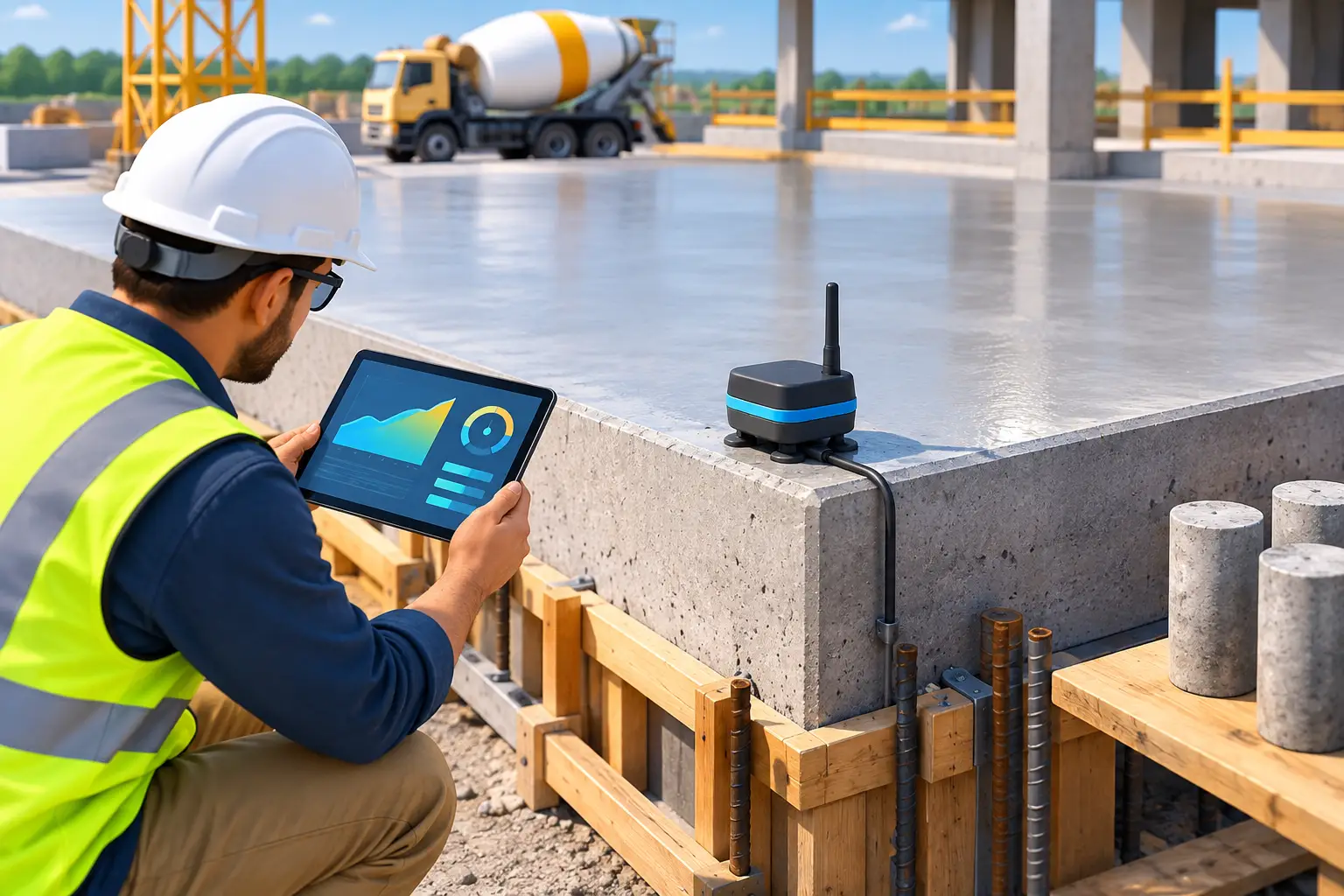
A bridge deck is placed at midnight. The crew needs a defensible answer before morning traffic control, not a guess based on the batch ticket or a cylinder sitting in a different environment. That is why use maturity meters is a practical question for any team managing critical concrete work. They turn the concrete’s actual temperature history into timely, location-specific strength information that supports better field decisions.
A maturity meter does not replace sound mix design, placement practices, or quality control. It gives the project team a clearer view of what is happening inside the placement after the trucks leave. For contractors, inspectors, and QA teams, that visibility can mean fewer unnecessary waits, fewer site visits, and stronger documentation when schedule pressure is high.
What a maturity meter measures
Concrete strength development is driven largely by time and temperature. Fresh concrete does not gain strength at the same rate in a cold footing as it does in a protected precast form or a mass placement retaining heat at its core. A maturity meter records the temperature history at the point where the sensor is installed, then applies an established maturity relationship to estimate in-place strength.
Under ASTM C1074, the process begins with a strength-maturity relationship for the project mix. Laboratory-cured specimens are tested at selected ages, and their strength results are correlated to calculated maturity values. Once that relationship is established, field temperature data can be converted into an estimated in-place strength.
That distinction matters. A temperature sensor alone tells the team whether concrete is getting cold, hot, or retaining heat. A properly developed maturity program can also support strength-based decisions such as form removal, post-tensioning, opening to traffic, or lifting precast elements. The quality of the answer depends on the project-specific calibration, correct sensor placement, and a monitoring plan that matches the specification.
Why use maturity meters instead of waiting on cylinders?
Cylinders remain a familiar part of concrete quality programs, and many specifications still require them. But standard-cured cylinders do not necessarily experience the same temperatures, moisture conditions, or curing environment as the structure. Even field-cured cylinders are a sample of the placement conditions, not a continuous record from inside the critical member.
Maturity monitoring gives the team a direct record from the element that matters. If a deck pour cools quickly overnight, the system shows it. If a heavily reinforced pier cap holds heat longer than expected, the data shows that too. Rather than waiting for a scheduled break or dispatching someone to retrieve and test specimens simply because the clock says so, the team can evaluate actual in-place conditions.
This is where the schedule value becomes concrete. A crew may be ready to strip forms, stress tendons, move a paving operation, or release a precast product. The decision should be based on verified strength criteria, not on a conservative time assumption that adds avoidable delay. When maturity results indicate the target has not been reached, the same visibility prevents an early release that could create a quality or safety problem.
The trade-off is straightforward: maturity monitoring requires preparation. The mix needs a valid strength-maturity curve, sensors must be installed before placement, and responsible personnel must understand the project acceptance criteria. For high-consequence placements, that preparation is generally far less disruptive than managing a delayed operation with incomplete data.
Better control of curing conditions
Maturity meters are valuable not only at the moment a strength target is reached. Their temperature record helps teams manage curing while there is still time to act.
Cold-weather concrete is an obvious example. A falling internal temperature can slow strength gain and raise the risk of poor early-age performance. With live monitoring, crews can confirm whether insulation, enclosures, or heat are maintaining the required conditions. They are not relying on a single ambient reading from outside the forms.
Hot-weather and mass concrete work present the opposite concern. High internal temperatures can accelerate early strength development while creating temperature differentials that demand close attention. Sensors placed at the core and near the surface help the team see the thermal behavior of the placement. That record supports curing adjustments and provides evidence that the work was monitored according to the project plan.
Sensor location is not a minor detail. The critical location may be the coldest edge of a slab, the core of a large foundation, a stressed end of a girder, or a section exposed to wind and low overnight temperatures. One sensor can be useful, but it cannot represent every condition in a large or complex placement. A good monitoring plan identifies the locations where a missed strength target or adverse curing condition would have the greatest consequence.
Fewer trips, faster communication, stronger records
Traditional monitoring often creates a chain of manual work: visit the jobsite, take readings, collect cylinders, transport samples, wait for breaks, relay results, and assemble documentation after the fact. That process can work, but it is labor-intensive and leaves gaps between observations.
Wireless maturity monitoring changes the workflow. Embedded or reusable sensors capture the temperature history continuously, while connected loggers, gateways, or cellular devices deliver the information to the people who need it. A superintendent can check an overnight pour before mobilizing a crew. A QA manager can review multiple placements without driving between remote sites. An inspector can see the same time-stamped record used by the contractor.
The benefit is not merely convenience. Decisions move faster when everyone is working from the same data. Automated alerts can notify the team when concrete approaches a strength threshold or when temperature conditions fall outside the project’s limits. Instead of discovering an issue at the next scheduled check, the team can respond while curing measures can still make a difference.
Documentation also improves. A maturity report should show the sensor location, temperature history, maturity calculation, applicable strength relationship, and time the required strength was achieved. When reports are generated from recorded data rather than reconstructed from handwritten notes, they are easier to review and more defensible during owner, agency, or quality audits.
Where maturity monitoring delivers the most value
Not every small placement needs the same level of instrumentation. For routine work with low schedule sensitivity, conventional sampling may be sufficient. Maturity monitoring earns its place where a strength decision controls valuable labor, equipment, access, or public use.
Overnight bridge-deck pours are a clear fit because traffic closures and reopening windows are expensive. Pavement projects benefit when crews need to know when a lane can safely reopen. On remote civil work, connected monitoring can eliminate unnecessary travel just to verify curing conditions. High-rise work benefits when form cycling depends on reaching a specified strength. Precast and prestressed producers can use maturity data to manage stripping, detensioning, and production flow across multiple forms or plants.
It also matters on projects with demanding compliance requirements. Agencies and owners may require evidence that concrete achieved a specified strength before a particular operation. A well-run ASTM C1074 program provides a traceable record tied to the actual placement, while still fitting alongside required cylinder testing and other specification controls.
Making maturity data reliable in the field
The best hardware cannot correct a weak monitoring plan. Before the pour, confirm that the strength-maturity relationship represents the production mix, including planned admixtures and cementitious materials. Establish the required strength thresholds in writing, define sensor locations, and identify who receives alerts and who has authority to release the next operation.
During placement, protect sensors and record their locations accurately. After placement, verify that data is transmitting and that the temperature history is being reviewed, not simply stored. For work with changing mix proportions or conditions, confirm with the project team whether a new or updated calibration is necessary.
The objective is controlled decision-making, not a number on a dashboard. Teams should use maturity estimates within the limits of their validated ASTM C1074 program and maintain required testing where the specification calls for it. That approach gives the project both speed and defensibility.
Wake’s HardTrack platform is built for this kind of field execution, with wireless deployment options that put live temperature and maturity information in the hands of the crew, QA team, owner, and inspector without exposed rebar wiring or routine manual collection.
When the next critical pour is on the schedule, the useful question is not whether concrete has had enough time. It is whether the team can prove what the concrete has actually done.