
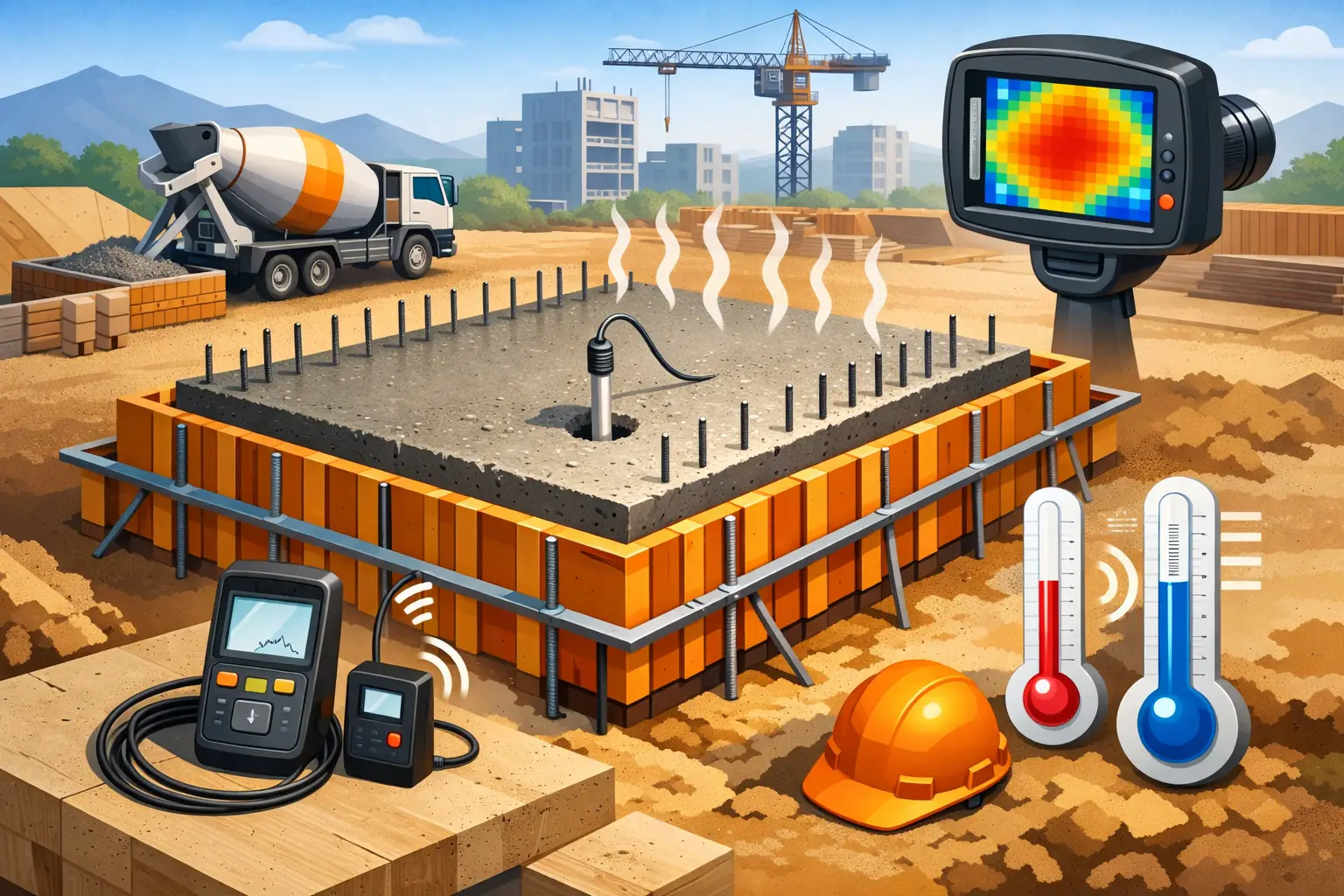
A mass concrete placement can look fine at the surface while its core is still gaining heat. By the time a crew discovers an excessive peak temperature or core-to-surface differential, the condition may be impossible to correct. That is why knowing how to monitor mass concrete temperature starts before the first truck arrives, not after the pour.
For bridge footings, thick pile caps, mat foundations, dam elements, tunnel work, and other high-volume placements, temperature monitoring is a control process. The objective is to document the concrete's thermal history, verify it remains within project limits, and give the team enough notice to adjust curing or cooling actions while those actions can still matter.
Start with the thermal control plan
Mass concrete is concrete with dimensions large enough that heat from cement hydration can create unacceptable temperature rise, thermal gradients, or both. The exact dimensions and limits are project-specific. They depend on cementitious materials, mix design, placement temperature, member geometry, ambient conditions, insulation, curing method, and structural restraint.
Before placement, establish a written thermal control plan that identifies the maximum concrete temperature, maximum internal temperature, and maximum allowable temperature differential. Many specifications use a core-to-surface differential of 35°F/19°C as a control value, but that is not a universal rule. The governing contract documents, engineer of record, and material requirements set the limits for the work.
The plan should also define where sensors will go, how often readings will be reviewed, who receives alerts, and what the team will do if temperatures approach a limit. A number without an escalation procedure is only a record of a problem.
Use trial-batch or thermal-model results to inform the plan when the placement is complex or the consequences are high. Modeling can forecast peak temperature and cooling behavior, but field monitoring verifies what the concrete actually does under jobsite conditions.
Place sensors where temperature matters most
A reliable monitoring program needs more than one sensor at a convenient location. Mass concrete temperatures vary through the section, especially during the first several days after placement. The center typically retains heat longest, while exposed faces cool first.
At a minimum, monitor the expected core and a location near the surface. The core sensor is generally placed near the point farthest from heat-dissipating surfaces. The surface sensor should be positioned beneath the curing and insulation system, not exposed to direct sun, rain, or cold air. It needs to represent the concrete temperature near the boundary where cooling is occurring.
For thick or irregular members, add intermediate-depth sensors. Multiple sensor strings may be needed across a large mat, a long wall, a footing with changing geometry, or locations with different exposure conditions. Corners, formed faces, construction joints, and transitions to thinner sections deserve particular attention because they can cool at different rates.
Before installation, confirm the sensor layout with the project engineer or QA/QC lead. Document each sensor's identification number, elevation, depth, horizontal location, and intended monitoring role. A live temperature graph is useful. A live graph tied to a clear sensor-location record is defensible.
Protect the measurement during placement
Install sensors securely so concrete placement, vibration, reinforcing steel congestion, or finishing operations cannot move them. The sensing element must be embedded in the concrete at the planned location, with enough lead protection or a fully wireless design to prevent damage.
Traditional wired systems can work, but exposed leads create a field risk. Wires can be cut, snagged, buried incorrectly, or left vulnerable between the pour and the data collection point. Wireless embedded sensors and reusable wireless loggers reduce those failure points while keeping the monitoring process out of the way of placing and curing operations.
Verify every sensor is communicating before concrete arrives. Record a baseline reading and confirm that the displayed data corresponds to the correct location. This simple pre-pour check prevents a great deal of post-pour confusion.
Capture temperatures often enough to act
The concrete does not wait for the next site visit. Heat generation commonly accelerates after placement, and the most meaningful changes can occur overnight, during weather shifts, or when a curing blanket is removed.
Set a recording interval that captures the rate of rise and cooling behavior. For critical mass placements, automatic readings at 15- to 60-minute intervals are typically far more useful than one manual reading per day. The right interval depends on the project requirements and expected thermal response, but the principle is straightforward: collect data frequently enough to see a trend before it becomes an exception.
Remote monitoring also changes the workflow. Field teams, project engineers, testing personnel, owners, and inspectors can review the same current data without making unnecessary trips to the placement. Cellular-connected systems are particularly valuable on remote infrastructure work, overnight deck pours, and projects where access is restricted after hours.
Ambient conditions should be part of the record. Air temperature, forecast changes, wind, solar exposure, and curing protection all affect surface cooling. GPS-specific weather information can help the team interpret a sudden shift in the differential and decide whether insulation needs to remain in place longer.
Track peak temperature and differential together
Two calculations drive most mass concrete temperature decisions: peak internal temperature and the difference between internal and surface temperatures.
Peak temperature is the highest temperature reached at a monitored location. Depending on the specification, the concern may be durability, delayed ettringite formation risk, material performance, or a stated project limit. The core may continue rising after the surface has begun cooling, so do not assume the highest temperature occurs on the day of placement.
The temperature differential is calculated by subtracting the near-surface temperature from the core temperature at the same time. A differential that rises rapidly is a warning that the exterior is losing heat faster than the interior. That temperature gradient can create tensile stresses near the surface and increase cracking risk when the concrete is restrained.
Review both the current value and the direction of change. A 25 F differential that is stable and declining presents a different decision than a 25 F differential that has increased by 8 F in the last few hours during a cold front. Trend data gives the team time to respond.
Define corrective actions before an alert arrives
When a monitored value reaches the action threshold, the response should be immediate and assigned. Typical measures include adding or maintaining insulation, adjusting enclosure heat, protecting exposed edges, delaying form removal, reducing cold-weather exposure, or managing internal cooling systems where the design includes them.
Every action has a trade-off. More insulation may reduce differential but can also allow the core temperature to climb higher. Removing insulation may limit peak temperature but can accelerate surface cooling. The right move depends on which limit is at risk, the current temperature trend, the forecast, and the engineer-approved thermal plan.
Avoid improvising after an alarm. Establish notification thresholds below the contractual limit so the project team has a decision window. For example, an alert might be configured when a temperature is approaching its maximum, when the differential is increasing at a defined rate, or when a sensor stops reporting. The response log should show who was notified, what was observed, what action was taken, and how the temperatures responded.
Use maturity data for strength decisions, but keep it separate from thermal control
Temperature data can support ASTM C1074 maturity testing when the project has an approved maturity relationship for the specific concrete mix. Maturity converts the time-temperature history into an estimated in-place strength, allowing teams to make better-informed decisions about form removal, post-tensioning, opening to traffic, or progressing to the next operation.
That is a major schedule advantage, especially when it reduces unnecessary cylinder breaks and waiting time. But maturity does not replace mass concrete thermal controls. A placement can meet a maturity-based strength target while still approaching a peak-temperature or differential limit. Treat strength verification and thermal management as related, but distinct, decisions.
A single platform can make that distinction easier to manage. Wake's HardTrack system combines wireless temperature monitoring, live project visibility, automated alerts, and specification-ready reporting so the temperature record remains available to the people making field and compliance decisions.
Build a record that stands up after the pour
The final deliverable should be more than a screenshot from a dashboard. Maintain sensor maps, installation records, calibration or verification information as required, temperature graphs, weather context, alert history, corrective-action notes, and final reports. Include the project limits used for evaluation and clearly identify the peak temperatures and maximum differentials observed.
This documentation protects the contractor and gives owners and inspectors a clear account of how the placement was controlled. It also improves the next pour. Compare the measured thermal response with the plan, then refine sensor locations, insulation duration, mix-temperature targets, or monitoring thresholds where needed.
The best mass concrete monitoring programs make the concrete visible while there is still time to manage it. Put sensors in the right places, watch the trends remotely, and give the field team a defined response before temperature becomes a schedule or quality problem.