
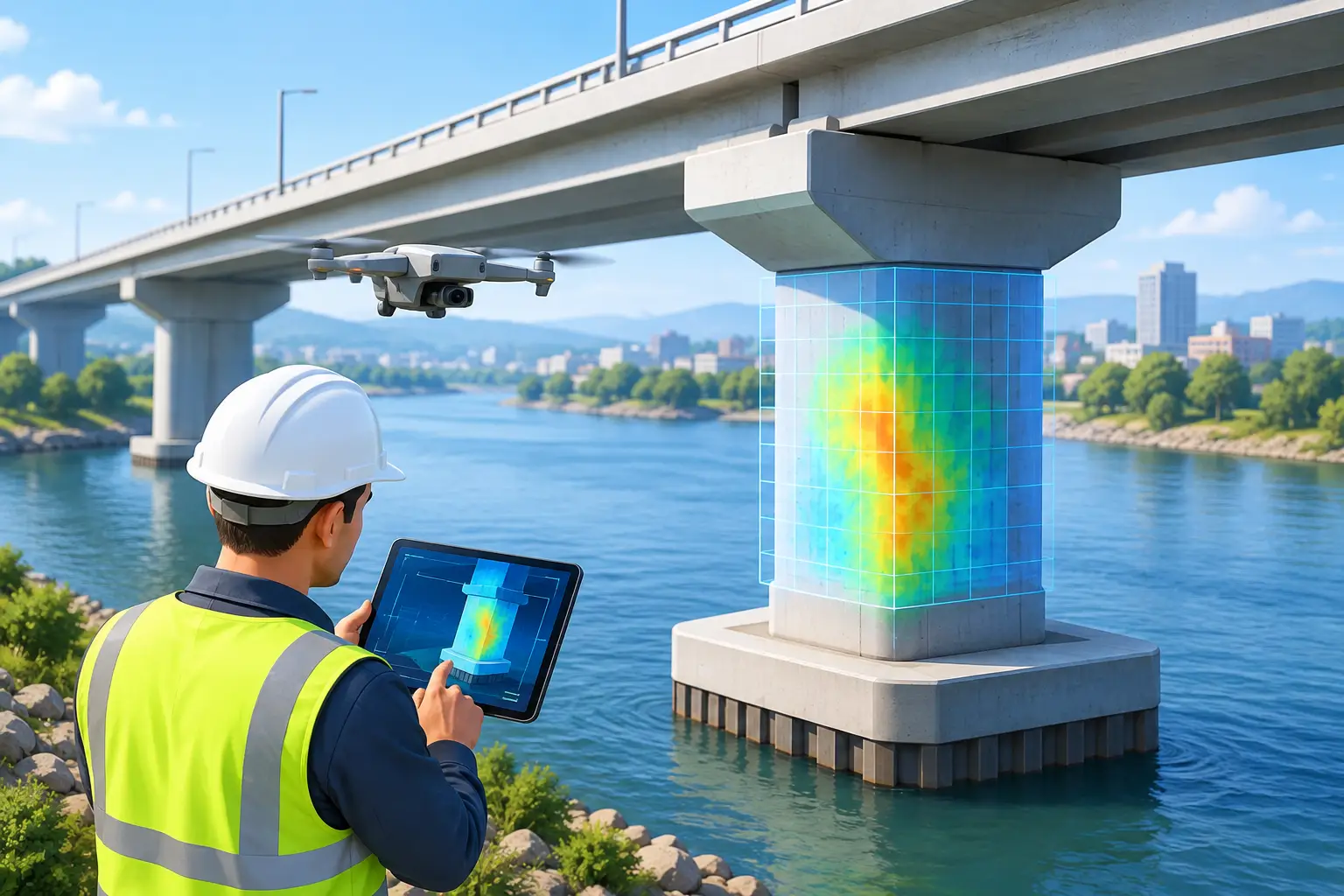
Bridge pier verification is not a paperwork exercise completed after the concrete has cured. It is the field decision process that tells the team when a pier has reached the in-place strength required for the next operation, whether curing conditions stayed within specification, and whether the project record will stand up to review.
For bridge contractors, the cost of guessing is immediate. A delayed form-strip decision can hold a cap pour, bearing installation, or girder-setting sequence. Releasing work too early creates a far larger problem: a question about structural performance, specification compliance, or both. The right verification program turns concrete temperature and strength development into timely, defensible field information.
What bridge pier verification must prove
A bridge pier is more than a vertical concrete placement. Its geometry, reinforcement congestion, mix design, ambient exposure, and construction sequence all affect how the concrete gains strength. Verification must therefore address the condition of the concrete in the pier, not simply the age of a set of cylinders stored elsewhere.
At a minimum, the project team needs to establish that the concrete has achieved the specified strength for the decision at hand. That may be strength for form removal, post-tensioning, loading, or a subsequent construction activity. The applicable drawings, specifications, and engineer's requirements control the acceptance criteria.
The team also needs evidence that curing conditions were acceptable. Cold weather can slow strength gain well beyond what a calendar-based plan assumes. Heat can accelerate early strength while creating temperature differentials that deserve attention in larger sections. When the placement is exposed to changing weather, real temperature history matters.
Finally, the information must be documented in a form an owner, inspector, or QA manager can review without reconstructing the story from handwritten notes, disconnected temperature logs, and lab reports. A verification record should connect the placement, sensor location, concrete mix, maturity relationship, temperature history, calculated strength, and release decision.
Why cylinders alone can leave a gap
Standard-cured cylinders remain an important part of many quality programs. They support mix qualification and provide a familiar test method. But they do not automatically represent the temperature history or strength development inside a bridge pier.
A cylinder may cure in a controlled environment while the pier experiences overnight cold, solar exposure, insulated forms, or heat generated by cement hydration. Field-cured cylinders can be closer to actual conditions, but they still require handling, storage, transport, testing, and carefully consistent procedures. They also provide a result at discrete intervals rather than a continuous view of what is happening in the structure.
That gap becomes costly when the crew needs an answer before the next shift. Waiting for a break test may mean holding equipment and labor. Taking more cylinders may improve confidence, but it also increases sampling, handling, and laboratory workload. The best approach depends on the specification and risk profile, but many bridge teams use maturity monitoring to supplement cylinder testing and make release decisions from actual in-place conditions.
Use ASTM C1074 correctly
ASTM C1074 provides the framework for estimating in-place concrete strength from temperature history through the maturity method. It is powerful because concrete temperature is measured where the work is occurring, and the resulting maturity index can be correlated with strength. It is not a shortcut around sound QA practice.
Before the placement, the concrete mixture needs a documented strength-maturity relationship developed in accordance with the project requirements. The datum temperature, maturity function, strength curve, and target strengths must be established for that mix or a properly qualified equivalent. A curve from a different mix design, cement source, admixture package, or production condition should not be assumed to apply.
During the pour, temperature sensors are installed at representative locations before concrete placement. The system records the time-temperature history, calculates maturity, and estimates strength against the approved relationship. The project team can then compare the estimate with the release threshold identified in the plans or specifications.
Maturity is not intended to diagnose every concrete issue. It does not replace visual inspection, consolidation controls, air-content testing, slump or slump-flow testing, batch documentation, cover verification, or engineering judgment. It also does not eliminate the need to monitor temperature differentials when thermal cracking is a concern. It gives the team a better answer to one critical question: how strong is this concrete, in this structure, right now?
Sensor placement should match the decision
Sensor location is where a technically valid monitoring plan becomes a useful field tool. A single sensor placed for convenience may not represent the area governing the construction decision.
For a typical pier shaft, place sensors where the concrete is expected to experience representative or governing thermal conditions. That may include the core of a large section, a more exposed exterior region, or a location near a planned construction joint. For complex pours, the engineer or QA plan may call for multiple locations to capture gradients and different curing environments.
The point is not to install more sensors than necessary. It is to install enough sensors to answer the actual release and curing questions with confidence. A pre-pour discussion between the contractor, testing agency, and owner team prevents a common failure mode: collecting temperature data that does not support the decision everyone needs to make.
Build verification into the pier workflow
The most reliable bridge pier verification programs are planned before the ready-mix trucks arrive. Start by identifying each decision point that depends on strength. Form stripping may require one threshold, while loading or advancing a major sequence may require another. Put those thresholds, the governing mix, and the responsible decision-maker in the placement plan.
Next, confirm the maturity calibration and sensor layout. Record sensor IDs, intended locations, elevation or placement zone, and the mix associated with each monitored area. Protect the sensors during placement and consolidation, then verify that data is being received as soon as practical after the pour begins.
During curing, use live temperature and strength information to manage the work rather than waiting for a scheduled test time. Automated alerts can notify the team when a target is reached or when temperatures approach a defined concern level. That is especially valuable on overnight pours, remote bridge sites, and projects where inspectors and managers cannot reasonably make daily trips just to retrieve a logger.
After the release decision, preserve the record. The report should show the approved strength-maturity relationship, the sensor data, calculated maturity and strength at the relevant time, and the decision basis. Clean reporting protects the contractor as much as it informs the owner. If a question arises weeks later, the team should be able to produce the evidence without searching through text messages and paper logs.
Where teams lose control
The most avoidable mistake is treating maturity as a device purchase rather than a verified method. A sensor without a mix-specific calibration curve cannot provide a defensible ASTM C1074 strength estimate. Likewise, a curve is not enough if the field sensor was placed in the wrong area, damaged during the pour, or never checked for data continuity.
Another problem is relying on calendar time. “Three days” may be meaningful only if the curing temperature is consistent with the assumptions behind the plan. On a cold, windy bridge project, it may not be. Continuous monitoring replaces that assumption with the actual thermal history of the pier.
Documentation can fail even when the concrete performs well. Reports that require manual transcription, isolated spreadsheets, or a field technician's memory are vulnerable to gaps. A connected system such as Wake's HardTrack platform can collect field data wirelessly, provide remote visibility, and produce specification-ready reporting without exposed rebar wiring or routine logger retrieval.
Make the next critical decision with evidence
Bridge work moves in sequences, and each sequence depends on knowing what the previous placement can safely support. The objective is not to generate more data. It is to give the superintendent, QA team, inspector, and owner a shared, time-stamped basis for moving forward.
When the monitoring plan is calibrated to the mix, sensors are placed with purpose, and records are available when decisions are made, bridge pier verification becomes a source of schedule control rather than a cause of delay. Let the pier's actual temperature history and in-place strength guide the next move.