
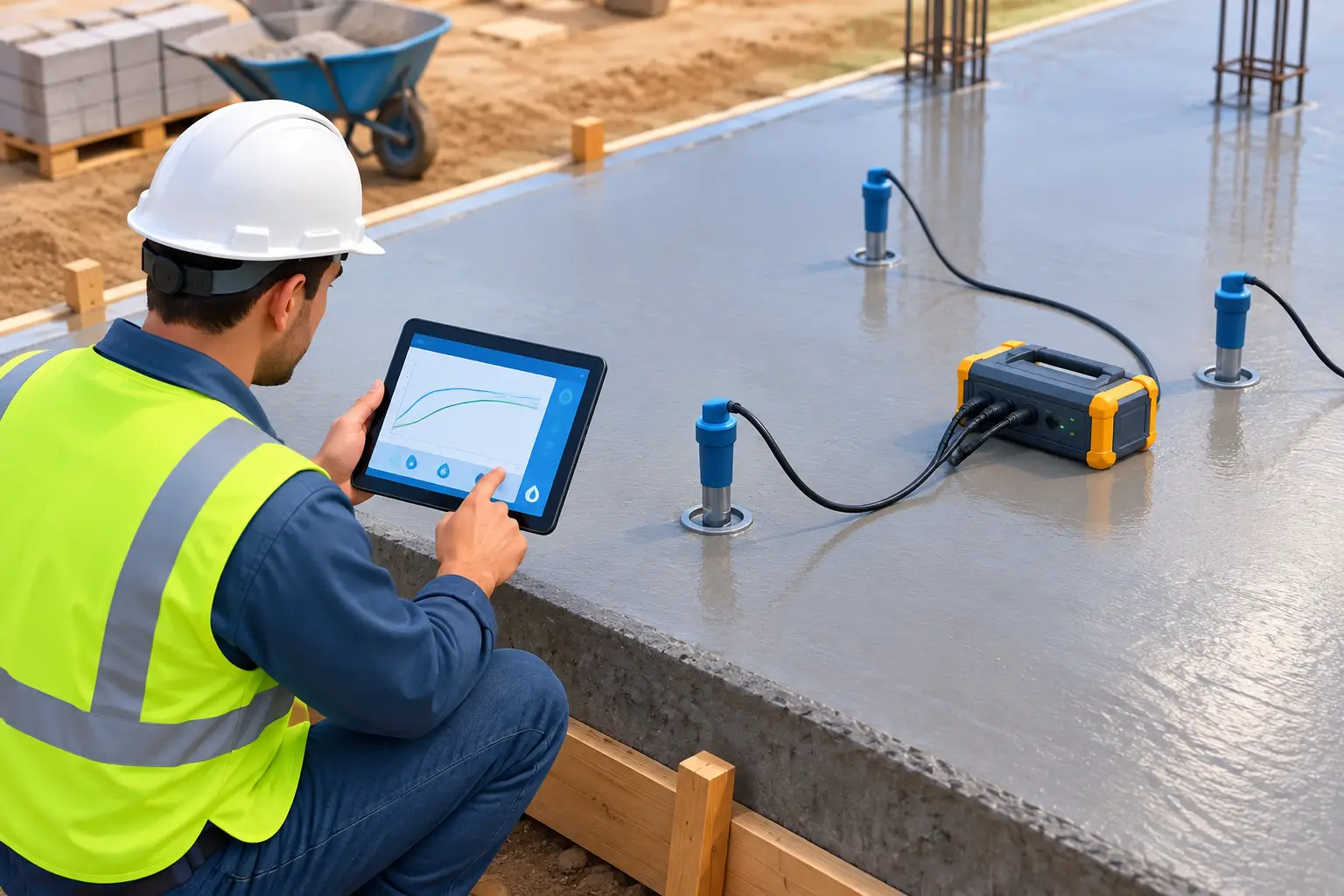
A bridge-deck pour placed at 2:00 a.m. does not wait for the morning shift to reveal whether curing conditions stayed within the specification. By then, a temperature excursion may already have affected strength development, thermal cracking risk, or the timing of critical next steps. Teams that monitor concrete hydration have a live record of what happened inside the placement, not an assumption based on ambient conditions or a single cylinder break.
Hydration is the chemical reaction between cement and water that produces heat while developing the hardened concrete's microstructure and strength. It is not something a crew can see directly. But internal concrete temperature, temperature differential, elapsed time, and maturity data provide practical indicators of how the reaction is progressing. For high-consequence work, that information supports better release decisions, more controlled curing, and documentation that can stand up to review.
Why Monitor Concrete Hydration Instead of Checking Weather
Weather matters, but ambient air temperature is not concrete temperature. A mass placement can retain substantial heat after the air cools. A thin slab can lose heat quickly in wind or low overnight temperatures. Insulation, formwork, mix design, cementitious materials, placement sequence, and solar exposure all change the thermal profile.
That is why a daily weather check or a temperature reading at the surface is rarely enough. The risk lives in the concrete itself. Internal monitoring shows whether the core is heating too rapidly, whether the surface is cooling too quickly, and whether the temperature differential is approaching the project limit.
The operational value is immediate. Rather than sending someone to a remote site to collect readings at set intervals, a project team can see current conditions, trends, and exceptions from the dashboard. Field personnel still make the decisions, but they make them with current data in hand.
What Concrete Hydration Monitoring Should Measure
A useful monitoring plan begins with the decision the data must support. On one project, the priority may be verifying in-place strength for post-tensioning or form removal. On another, it may be controlling maximum temperature and core-to-surface differential in a large footing, pier cap, or thick wall. Often, both matter.
Internal temperature and thermal differential
Internal sensors should be positioned where the thermal behavior is most likely to drive risk. In mass concrete, that commonly includes a warm core location and a location closer to the surface. The difference between those readings can indicate whether cooling is occurring faster at the perimeter than the interior can accommodate.
Maximum temperature also deserves attention. Project specifications may establish limits to manage durability concerns, delayed ettringite formation risk, or the thermal behavior of a particular mix. Monitoring does not eliminate the need for a thermal-control plan, but it confirms whether that plan is performing as intended.
Maturity and estimated in-place strength
Temperature history can also be converted into maturity using ASTM C1074 procedures and a mix-specific strength-maturity relationship. This gives the team an estimate of in-place strength based on the concrete that was actually placed, under the conditions it actually experienced.
That distinction is significant. Field-cured cylinders can be useful, but they are not always a reliable representation of the structure. They can be mishandled, stored under different conditions, missed during an overnight pour, or simply unavailable when the schedule needs an answer. A properly established maturity program can reduce unnecessary cylinder sampling while giving the project team faster evidence for strength-based decisions.
Maturity is not a shortcut around good QA/QC. The calibration curve must represent the approved mix, testing must follow the project requirements, and the strength threshold must be agreed upon. But when those controls are in place, maturity turns temperature data into a schedule-control tool.
Curing-condition documentation
A temperature record is also a curing record. It can show when the concrete was placed, how quickly it gained or lost heat, when protection was installed or removed, and whether a corrective action changed the trend. That history is valuable when an inspector asks for evidence, when a contractor needs to explain a schedule decision, or when a quality manager is reviewing an unexpected result.
The strongest records are continuous, time-stamped, and tied to the placement location. Manual logs can work on small, accessible pours, but they depend on consistent visits and leave gaps between readings. Automated monitoring makes the record more complete and less dependent on somebody being in the right place at the right time.
Build a Plan to Monitor Concrete Hydration
The best sensor is only as useful as the plan around it. Before the pour, identify the acceptance criteria: required strength milestones, maximum internal temperature, allowable temperature differential, monitoring duration, reporting format, and the people authorized to respond to an alert. Those details should be settled before concrete arrives, not after a reading causes concern.
Sensor placement should reflect the geometry and thermal model of the placement. A thick foundation mat, for example, may need core and near-surface measurements at several representative zones. A precast operation may focus on representative products or curing areas, using repeatable placement locations to compare cycles. A bridge deck may require attention to areas exposed to rapid cooling, especially during night work or changing weather.
It also helps to decide what each threshold means operationally. If the core temperature rises faster than anticipated, will the crew adjust insulation, cooling measures, or the curing sequence? If a maturity threshold is reached, who confirms the release decision? If data transmission stops, who checks the hardware? Clear ownership prevents the dashboard from becoming another screen nobody is watching.
Wireless Data Changes the Jobsite Workflow
Wired thermocouples have long provided useful temperature data, but exposed leads can be damaged during finishing, stripping, backfill, or routine traffic. They also create a collection step that ties the program to site visits. On a remote civil project or a placement monitored through the weekend, that process can be expensive and slow.
Wireless embedded sensors and reusable loggers reduce that friction. A sensor records conditions within the placement, while a nearby gateway or cellular-connected device transmits data to the cloud. The team can review the same information whether it is in the field trailer, the QA office, or offsite.
This approach is especially useful when stakeholders need different views of the same placement. The superintendent needs to know whether work can proceed. The QA manager needs defensible records. The owner or inspector may need a report showing compliance with the curing plan. One monitored data set can support all three without relying on handwritten transcription.
Wake's HardTrack platform is built for this kind of workflow, combining rugged wireless monitoring with live dashboards, automated alerts, and specification-ready Excel reporting. The practical benefit is not technology for its own sake. It is fewer unnecessary site visits, less uncertainty around strength milestones, and a cleaner chain of documentation.
Know the Limits of the Data
Monitoring provides visibility, not a substitute for judgment. A high internal temperature does not automatically mean the concrete is defective, and an acceptable maturity value does not override a project-specific hold point. Results must be evaluated against the mix design, structural requirements, specification limits, and the conditions of the placement.
Sensor location also matters. One reading cannot characterize a large, irregular placement with varying thicknesses, insulation conditions, or exposure. More sensors provide a fuller picture, but they add planning and interpretation. The right balance depends on the consequence of the work and the variability expected across the pour.
There is also a difference between detecting a problem and preventing one. A monitoring system can alert the team early, but the project still needs available materials, defined response actions, and personnel able to act. For example, an alert about rapid surface cooling is most valuable when insulation, curing blankets, or other measures can be deployed before the differential grows beyond the allowable limit.
Turn Readings Into Better Decisions
Concrete hydration monitoring works best when it is treated as part of placement control, not as paperwork collected after the fact. Review early trends while the placement is still active. Confirm that temperatures align with expectations. Watch the peak and cooldown period with the same attention given to the initial set. Then use maturity data and documented curing history to make the next decision with evidence.
For projects where a delayed pour, unnecessary cylinder break, or missing temperature record can affect far more than one shift, the right question is not whether concrete is curing. It is whether the team can prove how it cured and act before conditions put the work at risk.