
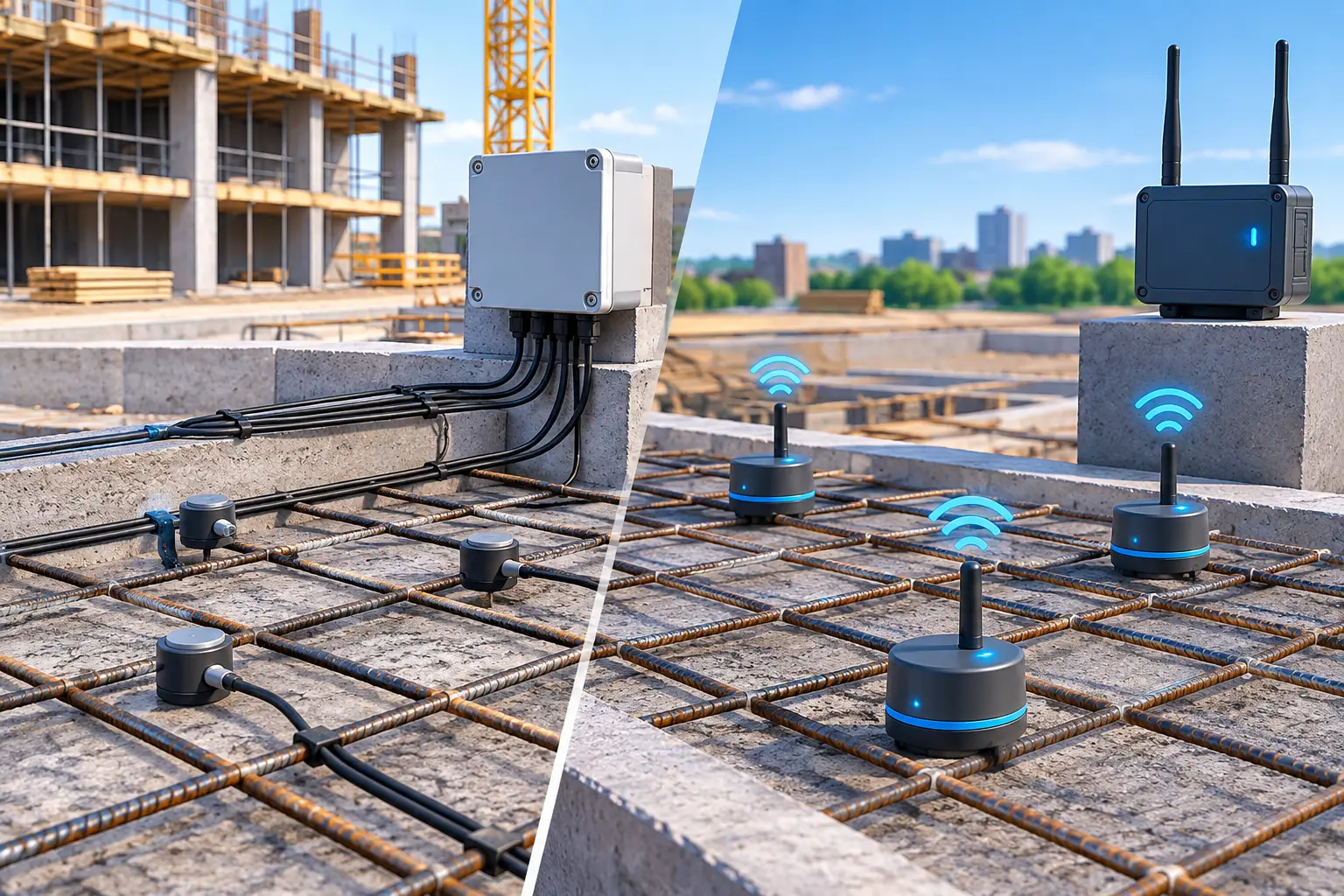
A bridge-deck pour placed late in the day does not wait for the next morning's cylinder break. The concrete is gaining temperature, losing heat, and developing strength whether anyone is on site to check it or not. That is the practical difference behind wired versus wireless concrete sensors: not just how temperature data is collected, but how quickly the project team can act on it.
For high-consequence concrete work, sensor selection affects more than convenience. It affects safe form removal, post-tensioning schedules, cold-weather curing response, inspector access to records, and the number of costly site visits required to keep a placement under control.
Wired Versus Wireless Concrete Sensors: The Core Difference
Wired systems generally place a temperature sensor in the concrete and run a lead wire out of the placement to a data logger, handheld reader, or manual measurement point. The temperature element remains embedded, but the wire becomes part of the jobsite environment. It must be routed, protected, identified, and kept intact through placement, finishing, curing, stripping, and other trades working nearby.
Wireless systems place the sensor and communications hardware inside the concrete or use a wireless logger connected to the sensor. Readings are transmitted to a nearby gateway, handheld reader, or cellular cloud connection, depending on the deployment. The team can retrieve data without following a wire back to an exposed connection point.
Both approaches can collect useful concrete temperature data. The better choice depends on the placement, the decisions tied to maturity data, the duration of monitoring, and the cost of missing information when it matters most.
Where Wired Monitoring Still Fits
Wired monitoring has been used on concrete projects for decades for good reason. It is familiar to many QA teams, can support direct local readings, and may fit a short-duration placement where personnel will be present throughout the monitoring period. A contractor with an existing wired data acquisition system may also use it effectively for controlled, repeatable applications.
For a small placement with protected sensor exits and a simple monitoring plan, a wired sensor can provide a straightforward temperature record. If the project only needs a limited number of readings and the area remains accessible, the operational burden may be manageable.
The trade-off appears when the placement is large, the pour runs overnight, or the sensor wires cross active work areas. Every wire exit is a potential damage point. A lead can be cut during finishing, pinched by forms, buried under insulation, disconnected from a logger, or mistaken for scrap material. Once a wire is compromised, the project may lose data from the exact location needed to support a strength decision.
Wired systems also tend to keep data collection tied to the physical placement. Someone must visit the sensor connection point, read the device, transfer the data, and communicate the result. That workflow can work, but it creates exposure when the project is remote, weather is poor, or the decision window falls outside normal shifts.
What Wireless Changes on the Jobsite
Wireless monitoring removes the exposed rebar wiring and changes the workflow from periodic collection to active visibility. Instead of sending a technician to each monitoring point, the project team can review current temperatures, maturity progression, and alerts from a shared dashboard or receive data through a connected gateway.
That matters most when schedule decisions cannot wait. Consider an overnight bridge-deck pour during cold weather. The team needs to know whether internal temperatures are tracking as expected, whether curing protection is working, and when the specified maturity target has been reached. A wireless system can make that information available before crews mobilize, rather than after someone reaches the site and retrieves a reading.
Wireless hardware also helps protect the monitoring program itself. Embedded sensors avoid the vulnerable wire run from concrete to an external logger. Reusable wireless loggers can support multiple locations across a placement. Cellular-connected configurations can send data from remote projects without relying on local Wi-Fi or daily manual downloads. For precast operations, portable readers and gateways can keep production teams informed across molds, casting beds, or multiple yards.
This does not mean wireless monitoring is automatic by default. The system still needs a deployment plan. Teams must confirm gateway range, signal availability where relevant, sensor placement, reading intervals, and who receives alerts. The advantage is that these steps create a repeatable process instead of a collection of manual checks.
Accuracy Depends on the Monitoring Plan, Not the Cable
A wire does not make a sensor more accurate, and a wireless signal does not make one less accurate. Meaningful results depend on sensor quality, correct installation, an appropriate data interval, and a monitoring plan that reflects the actual concrete risk.
Sensor location is especially important. A sensor near the surface may capture a different thermal condition than one at the core of a mass placement. A location near a heated enclosure, a cold form face, or a high-cementitious area can produce data that does not represent the decision point. The project team should identify the critical sections before placement and install sensors where temperature history will support real construction decisions.
For ASTM C1074 maturity testing, the concrete mixture's maturity-strength relationship also matters. Temperature history becomes actionable strength information only when the project uses a properly developed and approved calibration relationship for that mixture. Neither wired nor wireless equipment replaces that requirement.
The right system makes compliance easier by preserving the temperature record, maturity calculations, calibration inputs, and time-stamped results in a format the contractor, testing laboratory, owner, and inspector can review. A number read from a handheld device may answer an immediate field question. A complete, auditable record answers the question that comes later: how did the team verify strength before stripping forms, opening to traffic, or applying load?
Documentation Is Often the Deciding Factor
Many teams first compare sensor hardware, then discover the larger issue is documentation. Critical placements can generate hundreds or thousands of readings. If those readings are collected manually, someone has to compile them, check gaps, create reports, and distribute them to the people who need them.
A connected wireless platform can automate much of that work. Live dashboards give stakeholders the same current view. Automated alerts can notify the right people when temperature limits or maturity targets are reached. Specification-ready Excel reporting creates a clearer record without rebuilding data from handwritten logs or separate files.
This is where wireless monitoring earns its place on projects with tight inspection requirements. It gives field crews faster answers while creating documentation that is available to project engineers and QA personnel without waiting for a site visit. On major infrastructure work, that can reduce friction between production, quality, and owner oversight.
Wake's HardTrack platform is built around this operating model: rugged sensor options for the placement, flexible data collection methods for the site, and one shared record for the team making time-sensitive concrete decisions.
Choosing the Right Deployment for the Placement
The question is not whether every job must use wireless sensors. The question is where the risk and workload sit.
A short, accessible placement with a small monitoring scope may be adequately served by a wired arrangement, particularly when a technician is already present and the wire path can be protected. The economics and logistics change as pours become larger, sites become more remote, and decisions become more expensive.
Wireless monitoring is usually the stronger fit when the project involves overnight curing, restricted access, remote locations, long monitoring durations, multiple critical pour locations, or frequent requests for documentation. It is also valuable when a missed wire, missed reading, or delayed strength result could hold up crews, equipment, traffic shifts, or follow-on operations.
Before selecting a system, define the decisions the data must support. Identify the maturity targets, temperature limits, critical sensor locations, reporting requirements, notification recipients, and communications path. Then choose hardware that can survive the placement and deliver the information at the speed the project requires.
Concrete monitoring should not become another task that depends on someone remembering to drive back to the site. Build the monitoring plan around the moment a decision must be made, and make sure the data will be there when that moment arrives.