
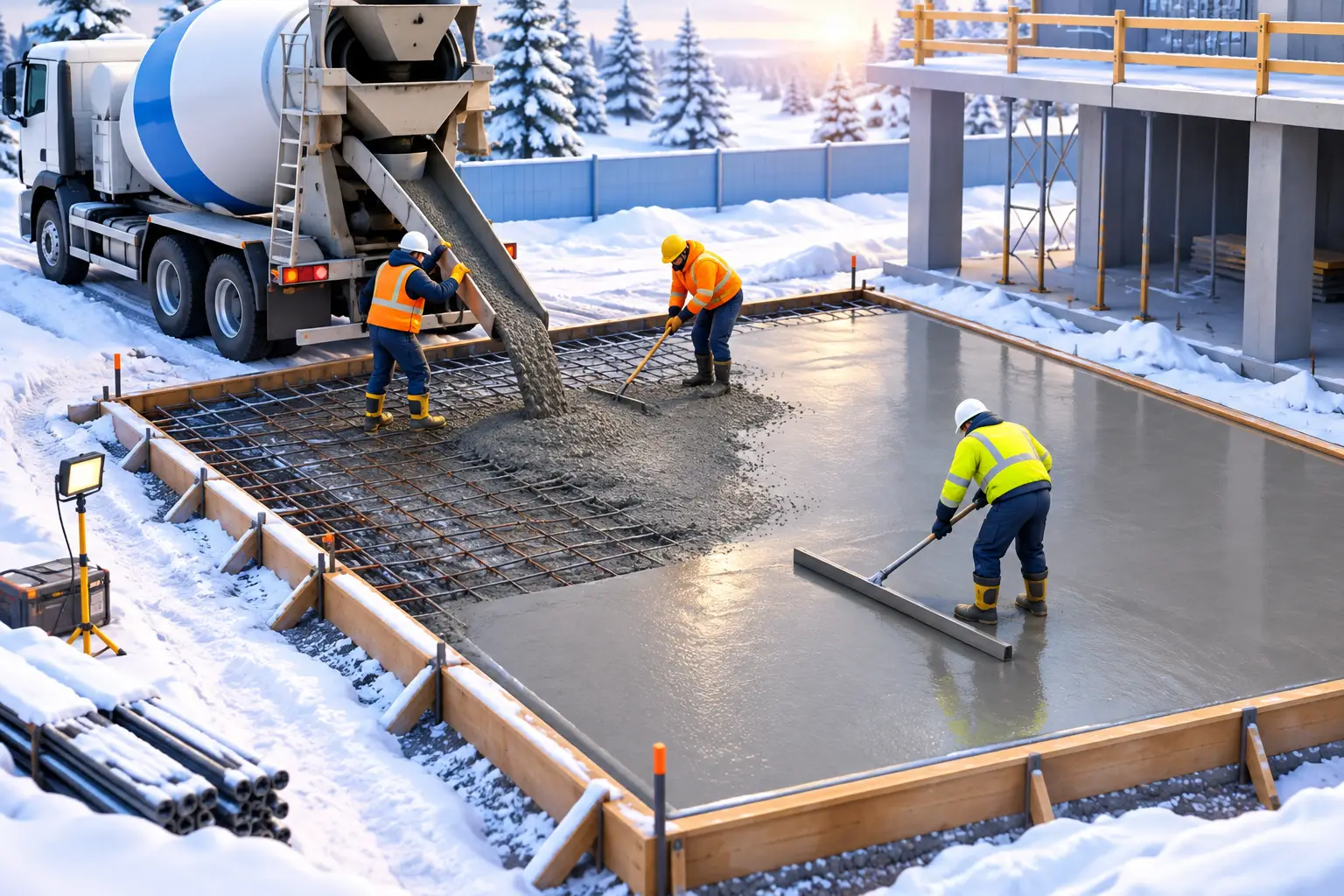
A winter concrete placement case study is most useful when it shows the decisions made between placement and strength release, not just the final test result. On cold-weather work, concrete can look protected while internal temperatures fall below the curing plan. That gap can cost a crew a shift, delay form removal, or create a documentation problem after the pour is complete.
The following representative scenario reflects the workflow used on high-consequence winter placements: monitor in-place conditions continuously, verify strength with an ASTM C1074 maturity relationship, and act on actual concrete data instead of an assumption based on ambient temperature.
The placement: a cold overnight structural pour
A contractor scheduled a 1,100-cubic-yard structural concrete placement for a bridge substructure in late January. The work required an overnight pour to maintain traffic control and keep the follow-on schedule intact. The forecast called for temperatures falling from 29 F at placement to 14 F before dawn, with wind increasing after midnight.
The concrete supplier provided a heated mix designed for cold-weather placement. The crew had insulated forms, curing blankets, and temporary enclosure materials ready. Those measures addressed the plan on paper, but they did not answer the questions that mattered once the trucks began arriving: Was the concrete maintaining the minimum curing temperature? How fast was it gaining strength? Could the contractor safely remove protection and proceed with the next operation on time?
Cylinder breaks alone would not provide those answers soon enough. Field-cured cylinders can be affected by conditions that do not precisely match the structure, and lab-cured cylinders do not represent in-place temperature history. The team needed a direct record from the concrete itself.
The monitoring plan started before the first truck
Before placement, the QA/QC team reviewed the project-specific maturity calibration curve and the required strength thresholds for formwork release and subsequent loading. This step matters. ASTM C1074 maturity is not a generic temperature-to-strength shortcut. The maturity relationship must be established for the approved mix design using strength-test data.
The team identified the placement zones most likely to behave differently: exposed outside corners, the top of the section near the curing blankets, and the deeper interior mass. Sensors were installed at representative locations before concrete placement, with each sensor assigned to a defined pour area and reporting point.
Wireless monitoring removed a common winter-pour vulnerability: exposed thermocouple wires routed out of forms and protection. Wires can be damaged during consolidation, snagged during blanket installation, or disconnected when crews are working in the dark. Embedded wireless sensors stayed with the concrete, while a cellular-connected system transmitted temperature and maturity information to the project team remotely.
The setup also included alert thresholds. One alert was established for a low internal temperature that could indicate inadequate protection. Another was set for unusually high temperature development, since a heated mix, large section, and insulated forms can create an internal temperature differential that deserves attention. Winter placement is not only about keeping concrete warm. It is about controlling the full thermal condition of the placement.
What the data showed through the first night
At placement, concrete temperatures were within the project target range. During the first several hours, the sensors showed expected heat development as hydration accelerated. The interior sensor remained stable, but the exterior corner sensor began cooling faster than the rest of the placement shortly after the ambient temperature dropped.
That was the moment the monitoring program paid for itself. The concrete had not yet reached a critical temperature, and the crew was still available to respond. The superintendent received an alert, checked the live temperature trend, and found that the exposed zone was losing heat more quickly than anticipated.
The response was specific rather than broad. The crew added blanket coverage at the affected corner, closed a gap in the enclosure, and adjusted temporary heat distribution. There was no need to send labor across the entire placement or apply heat blindly to areas that were already performing as planned.
Within the next monitoring interval, the cooling rate flattened. The corner temperature stabilized above the project minimum, while the interior temperature remained below the maximum differential limit. The placement stayed within the curing plan without interrupting the overnight operation.
Why ambient weather was not enough
The National Weather Service forecast correctly signaled a difficult night. It could not tell the contractor what was occurring inside the structural concrete. Wind, form geometry, insulation continuity, heat source placement, and concrete mass all influence in-place temperature.
Ambient conditions are essential for planning. Embedded concrete data is what supports a release decision. That distinction is especially important on bridge decks, walls, pier caps, precast elements, and other placements where one exposed area may cool much faster than the rest of the pour.
Strength verification replaced the waiting game
By morning, the project team had a continuous temperature record and calculated maturity values for each monitored location. The data indicated that the protected placement was gaining strength at the expected rate, but not uniformly. The interior zone was ahead of the exterior corner, which was exactly why a single temperature reading would have provided an incomplete picture.
The QA/QC manager compared the maturity results with the approved strength-maturity relationship. The required early-strength threshold for the next construction activity had not yet been reached at the coldest representative location. Rather than guessing or relying on a calendar-based hold time, the team kept the protection in place and rescheduled a small crew assignment for later that day.
A few hours later, the representative sensor reached the required maturity index. The system documented the temperature history, maturity calculation, time of strength attainment, and the location of the monitored concrete. The contractor released the next operation based on the actual condition of the placement.
That is the practical value of maturity testing in winter: it can prevent both premature action and unnecessary delay. If the concrete is not ready, the data gives the team a defensible reason to wait. If the concrete reaches the required strength sooner than a conservative cold-weather assumption suggests, the same data can help protect the schedule.
The documentation was part of the deliverable
For high-stakes work, a successful placement is not complete when the concrete reaches strength. The project team also needs records that can be reviewed by the owner, inspector, and quality personnel without reconstructing the event from handwritten notes.
The report for this placement included sensor locations, placement times, temperature trends, maturity values, alert events, and the time each monitored location met the specified strength threshold. It also showed that the corrective action occurred before the concrete fell below the curing requirement.
This record changed the conversation with stakeholders. Instead of saying that blankets and heaters were used, the contractor could show the resulting in-place temperature history. Instead of stating that the concrete should have reached strength, the team could provide an ASTM C1074-based verification tied to the approved mix calibration.
With a platform such as HardTrack, that record can be shared while the placement is active, not assembled days later. Project engineers, field QA staff, and remote decision-makers work from the same live information, reducing the delays that come from chasing readings by phone or waiting for a site visit.
What this winter concrete placement case study teaches
The lesson is not that every cold-weather pour requires the same sensor count, protection method, or release threshold. It depends on section size, exposure, mix design, project specifications, required strength, and the consequences of a delay. A lightly loaded slab-on-grade and a post-tensioned bridge element do not carry the same risk profile.
But the operating principle is consistent: build the monitoring plan around the decisions the team will need to make. Identify likely cold spots and heat-retaining zones. Confirm the maturity calibration before placement. Establish alerts that prompt action early enough to matter. Monitor representative locations through the required curing period, then preserve the data in a report that stands up to review.
Winter work will always include uncertainty. Temperature monitoring and maturity testing do not change the weather, but they give the project team control over its response. When the next overnight pour is on the critical path, make the concrete talk before the schedule starts slipping.