
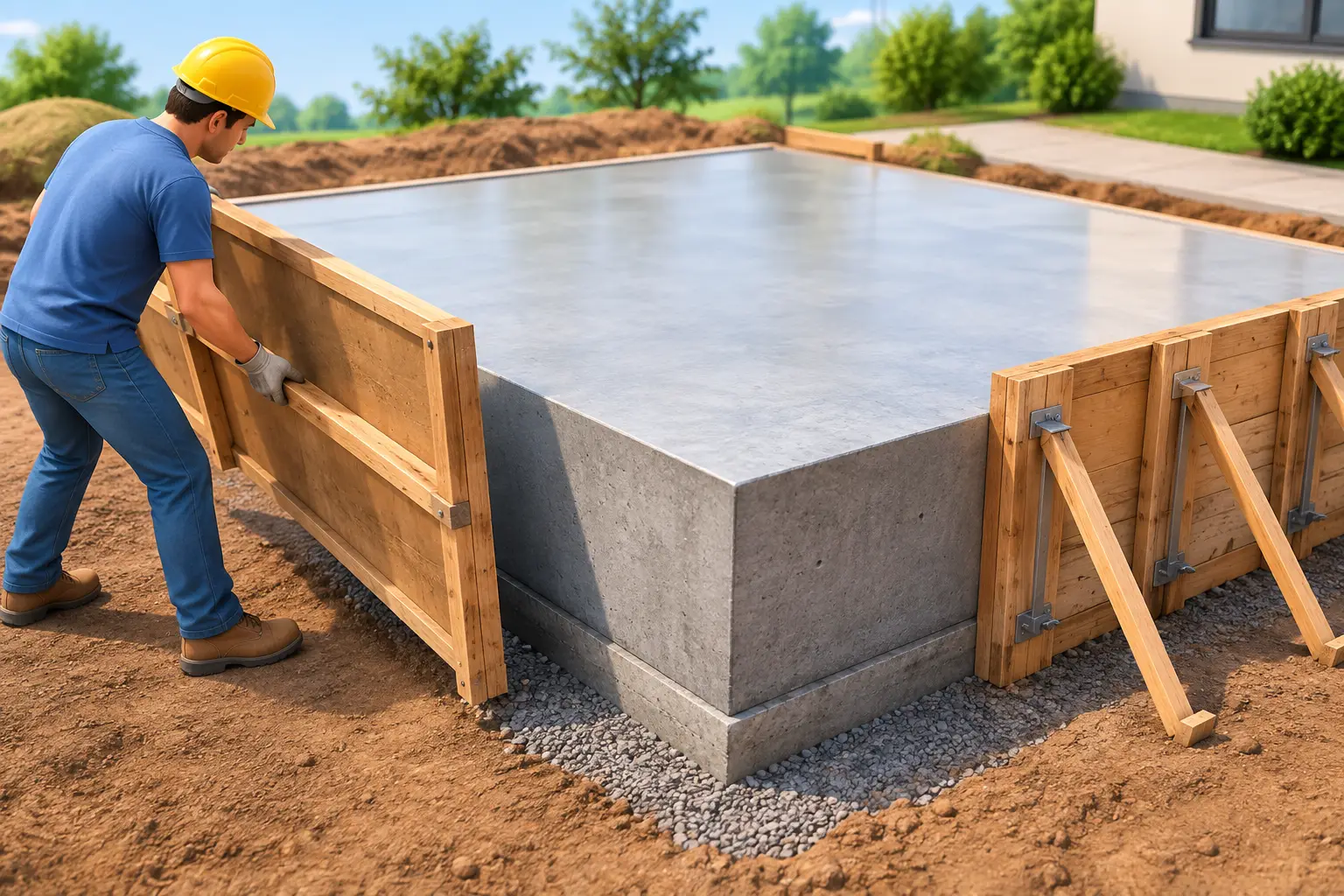
A wall form that comes off one shift too early can damage a finish, expose weak edges, or create a safety problem that costs far more than the hours saved. The question of when can forms be removed is not answered by the calendar alone. It is answered by the concrete’s in-place strength, the member being supported, the loads it will carry, and the project requirements governing the work.
For high-consequence placements, form removal should be a controlled release decision. Teams need evidence that the concrete has reached the specified stripping strength and that removing forms, shores, or reshoring will not compromise the structure, the finish, or the schedule.
When Can Forms Be Removed? Start With the Member
Not all forms serve the same purpose. Side forms on walls, columns, curbs, and vertical faces primarily shape fresh concrete and protect the surface while it gains enough strength to resist handling damage. Soffit forms beneath slabs and beams, by contrast, may be supporting the member’s self-weight and construction loads. Their removal requires a more conservative decision.
Vertical forms can often be removed at a lower strength than load-supporting forms, provided the concrete will not slump, crack, spall, or suffer damaged corners and edges. The required strength is set by the project specification, engineer of record, formwork designer, and applicable code requirements. Appearance specifications can matter as much as structural criteria on architectural concrete or exposed infrastructure work.
For elevated slabs, beams, decks, and other members that depend on shoring, stripping is only one part of the operation. The team must account for the concrete’s strength, expected deflection, span, reshoring plan, and the loads that remain or will be added above. A slab may have enough strength to remove selected form panels while still requiring shores or reshores to remain in place.
Time Since Placement Is Only a Starting Point
Many crews work from familiar stripping intervals: one day for wall forms, several days for slab forms, or longer for structural members. Those intervals can be useful for planning, but they are not proof of in-place strength. Concrete does not gain strength at the same rate on every project or even throughout one placement.
A mix with Type III cement, a warm placement temperature, and effective curing may gain early strength quickly. A mass placement, cold-weather pour, supplementary cementitious materials, a slow-strength-gain mix, or a member exposed to overnight temperature loss may develop more slowly. Concrete temperature is the variable that often turns a planned form-removal date into either a safe release or an unnecessary delay.
Cylinder breaks add information, but they can also create a gap between the laboratory sample and the concrete in the structure. Cylinders may be cured differently than the member, tested only at scheduled intervals, or unavailable when a field decision must be made. For schedule-critical work, teams need visibility into what the concrete is doing in place.
Use In-Place Strength to Make the Release Decision
ASTM C1074 concrete maturity testing gives project teams a practical way to estimate in-place strength from the concrete’s time-temperature history. Sensors installed in representative locations record temperature after placement. That temperature history is converted to a maturity index and compared with a strength-maturity relationship developed for the project mix.
The result is not a guess based on elapsed time. It is a documented estimate of the strength of the concrete where the sensor was placed. When the measured maturity reaches the value correlated to the specified stripping strength, the team has a defensible basis to evaluate form removal.
A maturity program must be set up correctly. The strength-maturity relationship must represent the actual mix design and materials. Sensors must be placed in locations that reflect the critical member conditions, not simply the most convenient location. The project specification may also require companion cylinders, field-cured cylinders, or other verification. Maturity data supports the decision; it does not override the engineer’s requirements or a clearly stated acceptance procedure.
HardTrack monitoring can provide that temperature history remotely, helping QA/QC teams see strength progress without waiting for a site visit or a scheduled break. For an overnight bridge-deck pour, a remote foundation placement, or a precast operation turning forms repeatedly, live maturity data turns form removal from a calendar assumption into a controlled workflow.
Separate Stripping Strength From Design Strength
One of the most common sources of confusion is treating stripping strength as if it were the concrete’s final required compressive strength. They are different thresholds with different purposes.
Stripping strength is the minimum in-place strength needed to remove a particular form system without damaging the concrete or creating an unsafe condition. Design strength is the specified structural strength used for the completed member. A concrete element can be ready for vertical form removal well before it reaches its 28-day specified strength. Conversely, a load-supporting form system may need to remain in place even after a general early-strength target has been reached.
The right target depends on the operation. Removing wall forms may require enough strength to prevent surface damage. Releasing a precast element may require strength sufficient for lifting stresses. Removing beam soffits may require analysis of loading and deflection. Opening a slab to equipment traffic is a separate question again, because wheel loads and concentrated construction loads can govern the decision.
Check the Conditions Around the Concrete
A strength result is essential, but it is not the only field check. Before stripping begins, the superintendent, formwork crew, and QA/QC personnel should confirm that the release sequence matches the approved formwork plan and that braces, ties, shores, and reshores are handled in the correct order.
Look closely at corners, edges, openings, blockouts, and thin sections. These areas may be more vulnerable to damage than the center of a wall or slab. Check for signs of freezing exposure, unexpected temperature loss, inadequate curing protection, honeycombing, or movement in the formwork. If the member will receive construction loads after stripping, confirm that those loads were considered in the reshoring and loading plan.
Curing should continue after forms come off when required by the project. Forms often help retain moisture and moderate temperature. Removing them may change the curing environment immediately, particularly in dry, windy, hot, or cold conditions. A strong stripping decision can still be followed by poor performance if curing protection disappears with the forms.
Build a Release Workflow That Holds Up in the Field
The most reliable programs make form removal a repeatable handoff, not a verbal decision made under schedule pressure. The workflow should identify the required stripping strength, the responsible decision-maker, the sensor locations or test requirements, and the records needed for the project file.
A practical release process has four connected steps:
- Establish the stripping-strength requirement for each member and formwork operation before placement.
- Monitor representative in-place conditions throughout curing, using maturity data and any required companion testing.
- Confirm the release threshold, field condition, stripping sequence, and reshoring plan before work begins.
- Record the decision with time-stamped strength data, temperature history, and the responsible approval.
That record matters long after the forms are gone. Owners, inspectors, and internal quality teams may need proof that removal occurred at the proper strength. Automated reports create a clearer trail than a handwritten note that says forms stripped at 7:00 a.m. They also help teams compare predicted and actual strength gain across placements, seasons, and mix designs.
Avoid the Two Costly Extremes
Removing forms too early creates immediate risks: damaged concrete, repair work, safety exposure, loss of dimensional control, and questions about quality. Keeping forms in place longer than necessary has a cost as well. It ties up form inventory, labor, cranes, finishing crews, and critical path activities. On repeated pours or high-volume precast production, conservative waiting can become a major schedule constraint.
The answer is not to strip aggressively. It is to remove uncertainty. When the team knows the specified release strength and can see real in-place strength development, it can act promptly when conditions are met and hold when they are not.
Concrete does not care what the schedule says it should have achieved. Measure what it has actually achieved, document the release, and let the next phase of work move forward with confidence.