
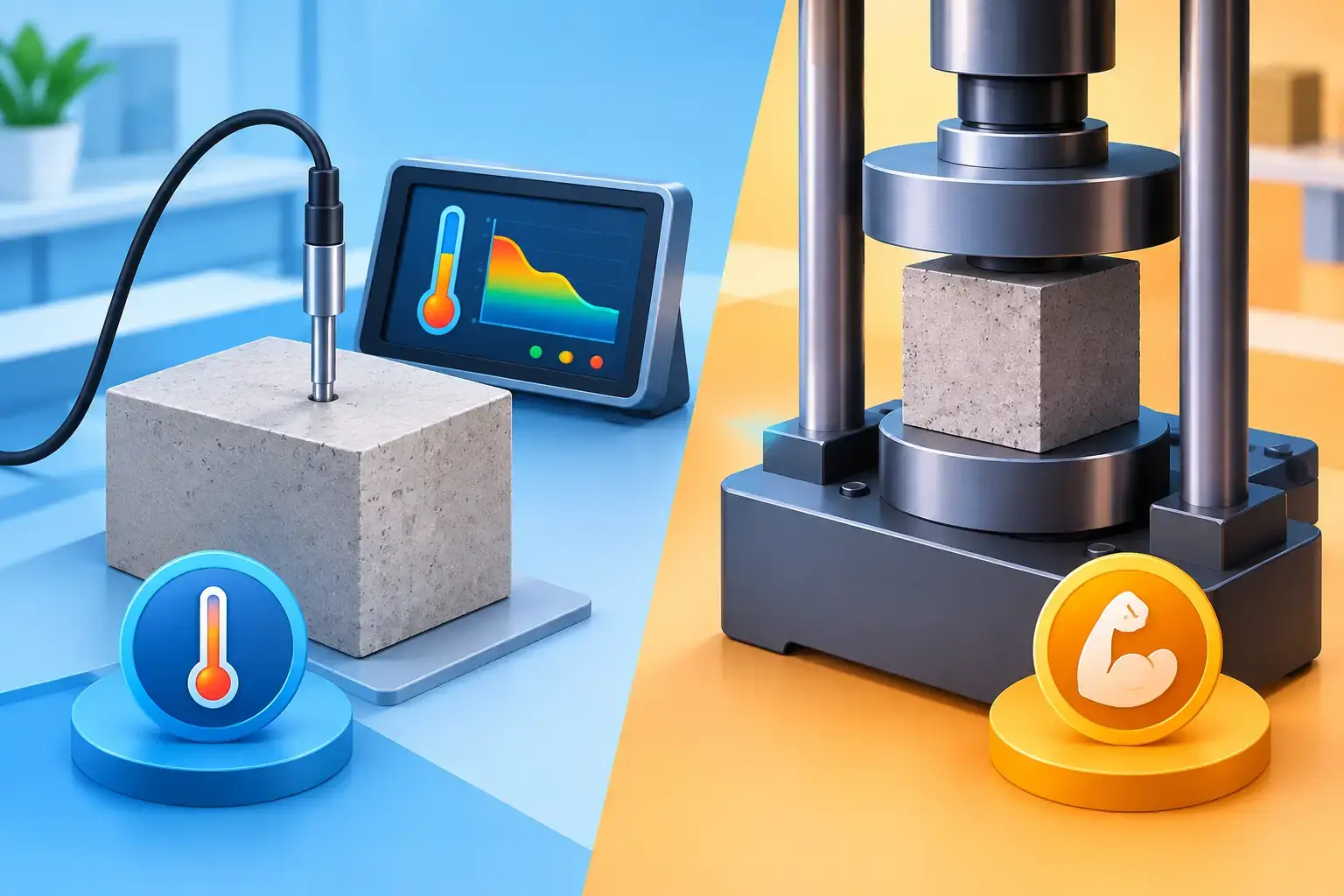
A bridge deck placed at 9 p.m. can look fine by sunrise while still carrying two very different risks: the concrete may not have reached the strength required for the next operation, and its internal temperature may be moving toward a thermal condition that creates cracking risk. That is why temperature monitoring versus strength testing is not a choice between competing methods. It is a decision about which question the project needs answered - and when.
For critical concrete work, the strongest quality programs use temperature data, strength verification, and project specifications together. The difference is in what each method can prove, how quickly it delivers information, and whether the result represents the concrete actually in the structure.
Temperature monitoring answers the curing question
Concrete temperature monitoring records the thermal history of a placement. Embedded sensors or wireless loggers track how hot the concrete gets, how fast it gains or loses heat, and how the internal temperature compares with ambient conditions or other parts of the structure.
That information matters because temperature drives hydration. A mass footing, pier cap, wall, precast member, or overnight paving placement can generate significant internal heat even when air temperatures are mild. Conversely, cold weather can slow hydration enough to jeopardize early-age strength and schedule commitments.
Temperature data helps field teams manage conditions that a compressive-strength break alone cannot reveal. It can show whether curing protection is maintaining required temperatures, whether a placement is approaching a specified maximum temperature, and whether the temperature differential between the core and surface needs attention. For mass concrete, those readings support decisions intended to control thermal stress and reduce the likelihood of cracking.
Temperature monitoring also provides immediate visibility. A project engineer does not need to wait for a laboratory break to see that insulation has shifted, heaters are underperforming, or a concrete mix is generating more heat than expected. Automated alerts and remote access are especially valuable for remote infrastructure work, overnight pours, and sites where a daily trip to read thermometers adds delay without adding control.
But temperature by itself does not establish compressive strength. A temperature curve can indicate whether concrete has experienced favorable curing conditions, but it cannot convert degrees into psi without a validated strength-maturity relationship.
Strength testing answers the acceptance and release question
Strength testing determines whether concrete has achieved a specified compressive strength. The most familiar approach is molding cylinders in the field, curing them under prescribed conditions, and breaking them in a laboratory at designated ages. Depending on the specification and purpose, teams may also use field-cured cylinders, cores, or other approved in-place test methods.
This testing is essential because structural acceptance requirements are written in strength terms. Owners, engineers, and inspectors need defensible evidence that the concrete meets the design and specification requirements. Cylinder testing remains a standard reference point for mixture qualification and quality control.
Its limitation is timing and representation. Standard-cured cylinders show the potential strength of concrete cured under controlled laboratory conditions. They are useful for acceptance, but they may not represent what the concrete in a cold bridge deck, heavily insulated wall, or heat-generating mat foundation is doing at that exact moment. Field-cured cylinders can better reflect jobsite conditions, yet they require handling, protection, transport, and timely breaks. They are also samples, not direct measurements from the placed element.
For release decisions, waiting for a scheduled cylinder break can create avoidable idle time. Crews may hold formwork, delay post-tensioning, postpone saw cutting, or wait to open a pavement section even when the in-place concrete has already reached the required strength. The opposite risk is more serious: assuming a scheduled age equals adequate strength when curing conditions have been unfavorable.
Where concrete maturity connects temperature to strength
ASTM C1074 maturity testing connects these two disciplines. The method uses the concrete's measured temperature history to calculate a maturity index, then correlates that index to strength through a project-specific strength-maturity relationship developed from the actual mix.
Once the relationship is established, an embedded sensor records the in-place temperature history, and the maturity calculation estimates the corresponding in-place strength. This gives the project a practical way to make strength-based decisions from the concrete in the structure rather than from a companion specimen alone.
That distinction is the heart of temperature monitoring versus strength testing. Temperature monitoring tells the team what curing environment the concrete experienced. Strength testing establishes the relationship between maturity and measured strength. Maturity testing uses both to estimate in-place strength when the work needs an answer.
For example, a contractor may need 3,000 psi before removing forms or applying post-tensioning force. Cylinder breaks used to build and verify the maturity curve supply the measured strength basis. The embedded sensor then provides a live maturity value for the actual member. When the calibrated relationship indicates the required strength has been reached, the team can document the release decision with a traceable record.
This approach can reduce unnecessary cylinder samples and eliminate some jobsite visits, but it is not a shortcut around quality control. The mix-specific calibration must be prepared correctly. Sensor placement must represent the critical location. The maturity method must be accepted by the project specification, engineer, or owner. Changes to mixture proportions, materials, or curing assumptions may require review or a new calibration.
Choose the method based on the decision at hand
The right program depends on the consequences of getting the decision wrong. A routine slab may only require conventional acceptance testing. A high-rise transfer slab, tunnel lining, precast girder, large pier, or airport pavement often needs more frequent and more immediate information.
Use temperature monitoring when the concern is curing performance, maximum temperature, temperature differential, cold-weather protection, or heat of hydration. It is the right tool when conditions themselves could damage quality or create a compliance issue.
Use conventional strength testing when the project needs mixture qualification, specified-age acceptance results, or independent verification of compressive strength. Those results remain central to a well-documented concrete quality program.
Use ASTM C1074 maturity when the operation depends on knowing in-place strength now. Form removal, tensioning, opening to traffic, load application, finishing sequence, and accelerated precast production are common examples. Maturity is particularly useful when the cost of waiting for a break is high and the cost of releasing too early is unacceptable.
In many cases, the answer is not one method or the other. A wireless system such as Wake's HardTrack can provide continuous temperature history for thermal control and the data needed for maturity-based strength estimates, while conventional cylinders continue to support calibration and specification requirements.
Build a program that produces defensible records
The technology matters, but deployment discipline determines whether the data is useful. Sensors should be installed at locations that reflect the most critical thermal or strength condition. In a thick placement, that may be the core and near-surface zone. In a precast operation, it may be the area that controls stripping or transfer. For a bridge deck, it may be the location most exposed to overnight cooling.
Before placement, the team should align on the governing thresholds: required release strength, maximum allowable concrete temperature, maximum differential, monitoring duration, maturity curve, and who receives alerts. That pre-pour alignment prevents the familiar problem of collecting data without a defined action tied to it.
Documentation should be just as practical. Time-stamped temperature histories, maturity calculations, sensor locations, calibration information, and release records should be available to the people making decisions and the people reviewing them. Cloud dashboards and specification-ready reports reduce the scramble to reconstruct what happened after a question is raised days or weeks later.
A concrete placement does not become predictable because a sensor was installed or a cylinder was cast. It becomes controllable when the team can see the curing conditions, verify the required strength, and act before schedule pressure turns uncertainty into risk.