
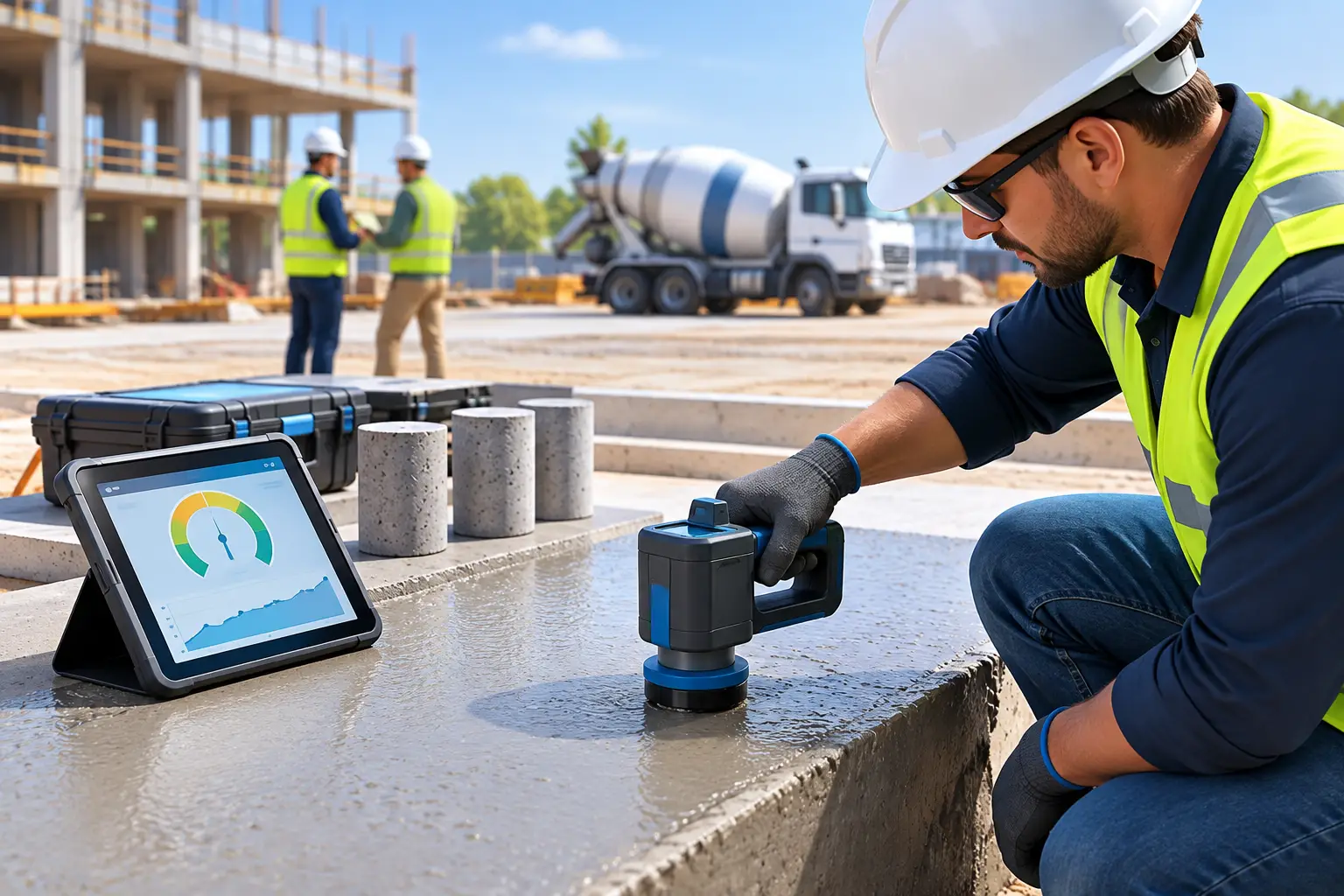
A bridge-deck pour placed before sunrise does not care whether the team has time for another cylinder break. It gains strength according to its actual temperature history. That is why maturity meter reviews need to look beyond a device screen or a claimed sensor range. The real question is whether a monitoring system gives the project team defensible in-place strength information when release, opening, stressing, stripping, or loading decisions are on the line.
For concrete contractors, QA/QC teams, precast producers, and inspectors, a maturity system is not a gadget. It is part of the quality-control process. The right system can reduce unnecessary field visits, support more targeted cylinder testing, document curing conditions, and keep a critical operation moving. The wrong one can create data gaps, add manual work, or leave the team scrambling for records when an owner asks for proof.
What Maturity Meter Reviews Should Actually Measure
The term “maturity meter” is often used broadly. In practice, concrete maturity testing is a complete ASTM C1074 workflow: a temperature sensor embedded in the concrete, a calibrated strength-maturity relationship for the mix, a method for collecting temperature history, and reporting that connects maturity to estimated in-place strength.
A useful review should evaluate that workflow from placement through final documentation. A temperature logger may be accurate and still be a poor fit if data must be collected manually from every sensor, cannot be viewed until the next site visit, or produces reports that require hours of spreadsheet cleanup. Conversely, cloud access is not enough if the system does not support the calibration and traceability needed for ASTM C1074 use.
Start by separating two questions: Does the equipment reliably measure concrete temperature? And does the overall system help the team make and document project decisions? Both matter, but the second is where many field programs either save time or lose it.
ASTM C1074 Support Comes First
Any serious review should begin with the maturity method, not the dashboard. ASTM C1074 requires establishing a strength-maturity relationship using the actual concrete mixture and test specimens. The system then applies the recorded temperature history to calculate maturity and estimate in-place strength from that relationship.
Look for a workflow that keeps the mix-specific calibration visible and tied to the placement being monitored. Teams should be able to distinguish one approved maturity curve from another when mix designs, cement sources, supplementary cementitious materials, or required strengths change. A convenient sensor cannot compensate for a curve that was not developed or applied correctly.
The review should also ask how easily the system documents the inputs behind a reported result. For high-stakes work, an estimated strength value without temperature records, sensor identification, mix information, and a clear calculation trail is difficult to defend. Inspectors and owners need more than a number. They need confidence in how that number was produced.
Evaluate the Jobsite Workflow, Not Just the Hardware
Concrete monitoring happens under conditions that are rarely clean, dry, or convenient. Sensors may be installed before a night pour, buried in congested reinforcement, exposed to vibration, or left in a remote location through changing weather. Reviews should examine whether the equipment is built for those realities.
Embedded sensors eliminate a common weak point in wired programs: leads extending from the placement to an external reader or data collector. Exposed wires can be cut, pulled, damaged, or become an obstacle during finishing and curing. Fully wireless embedded options reduce those risks, particularly on paving, bridge decks, mass placements, and heavily reinforced structural work.
That does not mean every project needs the same deployment method. A high-volume precast yard may prefer reusable loggers that can be read across multiple forms. A remote dam or utility project may need cellular-connected sensors and solar-supported gateways. A small, accessible placement may be well served by a handheld reader. Maturity meter reviews are most useful when they identify which configuration fits the actual work rather than naming one approach as universally best.
Remote Data Is a Schedule Tool
The value of remote visibility becomes obvious when a decision falls outside normal working hours. If a slab is approaching stripping strength overnight, the superintendent needs current information without sending someone to the site just to collect a reading. If low temperatures threaten a curing plan, the project team needs an alert early enough to respond.
Assess how data moves from concrete to the people making decisions. Cellular cloud-connected sensors can provide direct visibility from remote placements. Wireless loggers and portable gateways may support larger local networks where cellular service or deployment economics call for a different approach. The useful measure is not simply whether the system has an app. It is whether the assigned team can see current temperatures, maturity, and estimated strength at the moment action is required.
Data continuity matters as much as access. Ask what happens if a gateway temporarily loses power, a cellular connection drops, or a device is moved. A field-ready system should preserve the temperature history needed for the maturity record and make interruptions visible rather than silently leaving holes in the chart.
Reporting Is Where a Good Program Becomes Defensible
A maturity program creates value twice: first when it supports an operational decision, and again when it proves that decision was justified. That second purpose is often underestimated until a dispute, audit, owner request, or quality review arrives weeks later.
Strong reviews look closely at report quality. Can the system organize readings by project, placement, sensor, and mix? Can it show temperature history alongside maturity and estimated strength? Does it capture the date and time of key events? Can project-specific reporting be produced without manually copying values from multiple screens?
Specification-ready Microsoft Excel reporting is especially useful where the project team already relies on Excel for submittals, QA records, or owner deliverables. It allows data to move into established documentation processes without forcing field staff to rebuild reports by hand. The report should be clear enough for an inspector to review and detailed enough for a quality manager to retain as a permanent record.
A polished dashboard is helpful, but it is not the same as a complete record. If a review focuses only on screen appearance, it misses the part of the system that protects the contractor after the pour is complete.
Accuracy Needs Context
Sensor accuracy, temperature range, battery life, and wireless distance all deserve attention. But ratings should be read in the context of placement conditions. A stated range in open air may not reflect performance through dense reinforcement, formwork, structural concrete, or a large precast operation. Battery claims should be weighed against the expected monitoring duration, read frequency, and whether the equipment is disposable or reusable.
Installation discipline also affects data quality. The sensor must be placed at a location that represents the concrete and the decision being made. A thermal gradient near a surface, a heat source, or a massive core can produce meaningfully different results. For many placements, monitoring more than one location gives the team a clearer picture of curing performance and helps identify the controlling condition.
The best technology cannot correct an unsuitable sensor location or an unverified maturity curve. A good provider should make those requirements easier to execute through practical setup, clear project organization, and field support that understands concrete operations.
Compare Systems by Total Operational Burden
When reviewing options, compare the labor required before, during, and after placement. Manual systems can appear simple at the start, yet create recurring work when personnel must retrieve data, transcribe readings, update spreadsheets, and distribute reports. That burden grows quickly across multiple pours, distant sites, or weekend operations.
Automated monitoring can reduce those touchpoints, but only if the workflow remains straightforward for installers and foremen. The most productive systems make it easy to assign sensors, verify communication, view live data, set alerts, and retrieve documentation. They should not require a specialist to be present every time concrete is placed.
Wake’s HardTrack platform is designed around this operational reality, with deployment options for embedded wireless sensors, cellular monitoring, reusable loggers, and portable collection. The point is not technology for its own sake. It is giving each project a practical path to live, auditable maturity information without unnecessary jobsite visits or exposed wiring.
Questions Worth Asking Before You Select a System
Before accepting any maturity meter review at face value, ask whether the reviewer used the system on a real concrete placement and whether the review addresses ASTM C1074 calibration, sensor installation, communication reliability, alerting, and documentation. Also ask what type of project was involved. A tool that works well in a controlled precast plant may have different limitations on a remote bridge deck or a congested high-rise core.
Pay close attention to the handoff between field crews and decision-makers. Who installs the sensors? Who confirms they are reporting? Who receives alerts? Who approves stripping or loading? Who produces the final record? A monitoring system should clarify those roles, not create another isolated stream of data that no one owns.
The strongest maturity program is the one your team can execute consistently on the projects you cannot afford to get wrong. Choose the system that turns real concrete temperature history into timely decisions, reliable records, and fewer reasons to wait when the schedule is ready to move.