
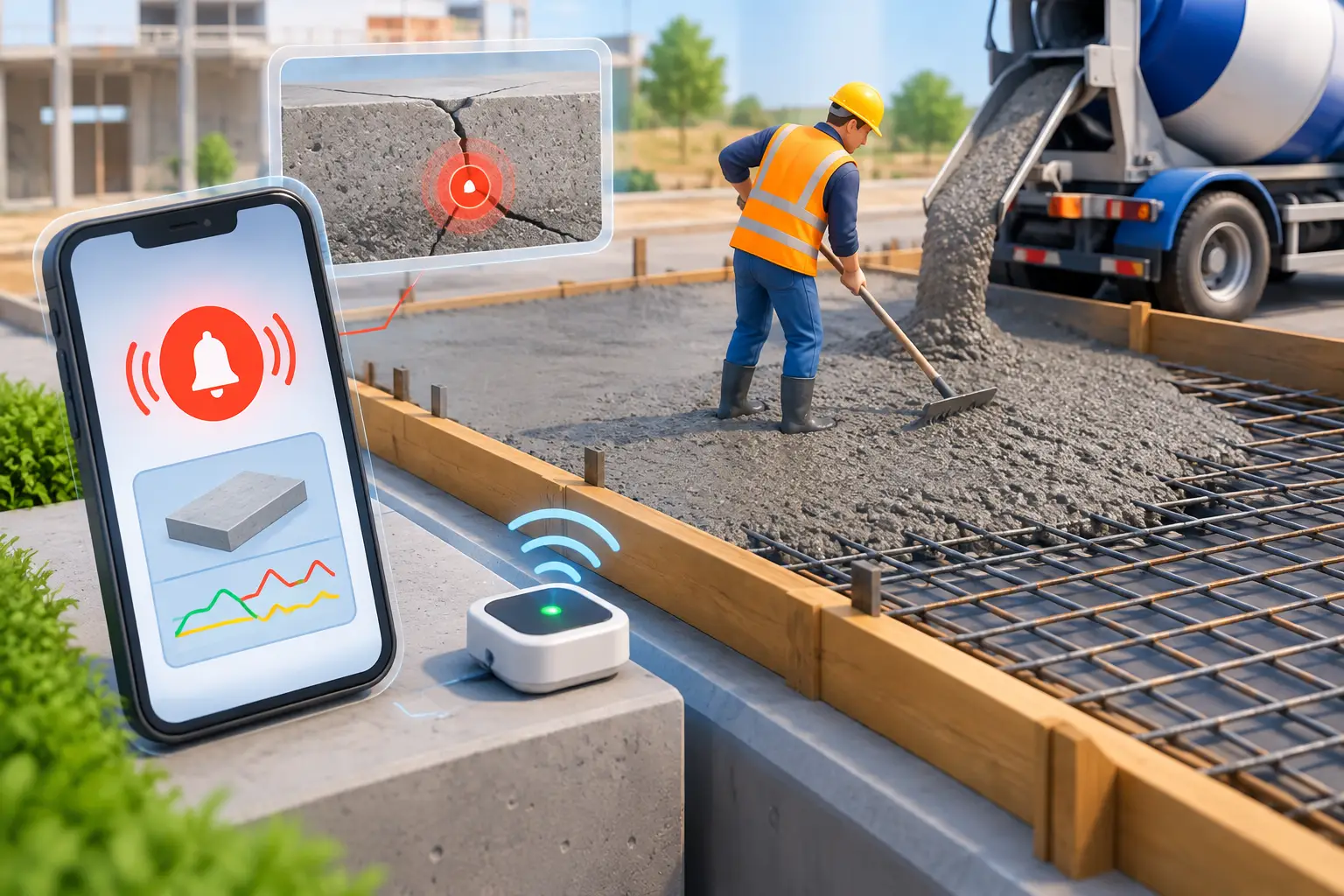
A bridge-deck placement does not wait for the morning shift to discover that internal concrete temperatures climbed too high at 2:00 a.m. The same is true when a cold-weather pour loses heat, a remote gateway drops communication, or maturity reaches a release target before the crew is ready. Knowing how to set pour alerts turns live monitoring data into a timely field decision instead of a report reviewed after the risk has passed.
The goal is not to notify everyone whenever a number changes. It is to give the right person a clear signal when a defined condition requires action. Well-configured alerts protect curing performance, support ASTM C1074 maturity workflows, reduce unnecessary site visits, and create a documented record of how the team responded.
Start With the Decision, Not the Sensor
Every alert should answer one practical question: what will the recipient do when it arrives? If that answer is unclear, the alert is probably noise.
For example, an internal temperature alert may prompt a superintendent to adjust insulation or cooling measures. A temperature differential alert may trigger a review of thermal-control provisions with the engineer. A maturity-strength alert may tell the project engineer that a formwork, post-tensioning, opening-to-traffic, or prestress-release decision is ready for verification.
This is where alert planning becomes part of the pour plan. Identify the decisions that affect safety, quality, production, and schedule, then configure monitoring points and notifications around those decisions. A sensor buried where nobody has assigned responsibility for reviewing it will not improve the outcome.
Before setting thresholds, confirm that the monitoring plan matches the placement. Sensor locations should represent the areas most likely to experience heat buildup, heat loss, or critical strength requirements. In a mass placement, that may mean comparing core and near-surface conditions. In a bridge deck or paving operation, it may mean tracking vulnerable edges, corners, and sections exposed to changing weather. For maturity monitoring, use the approved strength-maturity relationship for the mix and the project requirement being evaluated.
How to Set Pour Alerts Around Real Risks
A useful alert program generally covers five types of events: concrete temperature limits, temperature differential, rate of temperature change, maturity or estimated strength milestones, and communication or equipment status. Not every project needs all five, but every project should deliberately decide which ones matter.
Set temperature limits for the placement condition
High and low internal-temperature limits are the most direct alert conditions. They help the team identify when concrete is outside the curing range established by the specification, mix design, thermal-control plan, or engineer of record.
There is no universal alert value that fits every mix or placement. A large foundation mat has different heat-of-hydration behavior than a thin precast member or an overnight deck repair. Set the alert threshold below the actual project limit when possible. That buffer gives the team time to respond before the condition becomes noncompliant.
For cold-weather work, a low-temperature warning may be more operationally valuable than a failure-level alert. The warning can tell the crew to inspect blankets, heaters, enclosure conditions, or curing equipment before strength gain slows and the schedule begins to slide.
Watch the differential, not only the peak temperature
A concrete temperature that appears acceptable at the core can still create risk if the surface cools much faster. The difference between core and surface temperatures is often central to thermal-cracking control.
Configure a differential alert using paired sensor locations that reflect the thermal-control plan. The maximum allowable differential must come from project requirements and engineering direction, not a generic dashboard setting. Set an early-warning threshold first, then a higher escalation threshold if the differential reaches the action limit.
Rate-of-change alerts add another layer of control. A rapid drop may indicate insulation damage, heater failure, a weather shift, or premature removal of protection. A rapid rise can reveal unexpected heat development. These alerts are especially valuable when a crew needs to act before the next routine temperature check.
Set maturity alerts for the decisions that move work forward
Maturity alerts should be tied to actual project milestones, not simply to a target strength value copied from another pour. Common milestones include reaching the required strength for form removal, stressing, opening a lane, moving forms, lifting precast elements, or ending a specified curing period.
Use the approved maturity curve and the project-approved strength criterion. An alert that estimated maturity has reached a threshold is a prompt to verify the release decision under the project QA process. It does not replace the engineer's requirements, inspection hold points, or documentation rules.
When several milestones apply, configure separate alerts. A crew may need notice at an early handling strength, a later post-tensioning strength, and a final opening-strength target. Combining all of those into one alert forces people to interpret what the notification means at the worst possible time.
Build in Time, Persistence, and Escalation
A single sensor reading can be affected by placement activity, temporary exposure, or a brief communication interruption. Alert logic should reflect that reality.
For conditions that require confirmation, use a persistence period. Instead of alerting the moment a reading crosses a warning level, trigger the notification only if the condition remains beyond the threshold for a defined interval. The right interval depends on the placement. A fast-changing thin section may require a shorter window than a massive placement with slower thermal movement.
Use two levels when the consequence is significant. A warning informs the assigned field lead that a condition is approaching a limit. A critical alert goes to the person with authority to mobilize corrective action or elevate the issue. This approach prevents a routine warning from becoming an all-hands message while ensuring that a true exception is not missed.
Escalation also needs ownership. If the first recipient does not acknowledge the alert within the required response period, identify who receives the next notification. For overnight pours, that may be the night superintendent first and the project engineer second. For a precast operation, it may be the plant quality manager and production lead. The schedule is only protected when somebody is accountable for acting.
Configure the Data Path Before the Pour Starts
An alert is only as dependable as the data path behind it. Confirm that each sensor is assigned to the correct placement, location, and pour date. Use names that make immediate sense in the field, such as “Pier 3 Cap Core” or “Deck Span 2 East Edge,” rather than generic device IDs.
With a cloud-connected monitoring system such as Wake's HardTrack platform, teams can route live temperature and maturity information to a shared dashboard while maintaining deployment flexibility across embedded sensors, wireless loggers, portable gateways, and cellular-connected equipment. That flexibility matters when the placement is remote, the project has limited power, or conditions make wired thermocouple systems impractical.
Before concrete arrives, verify the transmission path, reporting interval, device battery or power status, and gateway placement. A gateway positioned behind steel, inside a poorly located enclosure, or beyond effective range can turn a well-designed alert plan into a blind spot. For cellular-connected devices, confirm that data is reaching the dashboard before the critical curing window begins.
Weather alerts require the same discipline. Forecast data can provide useful advance notice of cold, heat, wind, or rain, but it should complement in-place sensor information. A weather forecast is not evidence of concrete temperature or maturity. Use it to prepare crews and protection measures, then use actual monitoring data to confirm curing conditions.
Send Each Alert to the Person Who Can Act
Avoid sending every alert to the entire project distribution list. Broad notification creates alert fatigue, and alert fatigue creates missed exceptions.
The field superintendent typically needs immediate notice of curing and protection issues. The QA/QC manager or testing laboratory needs visibility into compliance-sensitive temperature and maturity data. The project engineer needs milestone notifications that affect sequence and release decisions. Owners and inspectors may need dashboard access or documented reports, but they do not always need an after-hours warning for every condition.
Define the message content as carefully as the recipients. A useful notification identifies the placement, sensor location, measured value, threshold, timestamp, and expected action. “Temperature high” is not enough. “Pier 3 cap core is 154°F at 1:40 a.m., exceeding the 150°F warning threshold. Inspect cooling-water flow and notify the thermal-control lead” gives the recipient a reason to act without first searching for context.
Test the Alert Plan on Pour Day
Do not wait for the first critical event to learn whether the message reaches the right phone, email address, or dashboard user. Run a short test before the placement begins. Confirm that the project is named correctly, sensor readings are visible, notifications are enabled, and escalation contacts are current.
Also verify practical details: time zones, shift handoffs, weekend coverage, and who documents the response. If the plan calls for corrective action, record what was done and when. That record is valuable during a QA review, an owner discussion, or a post-pour evaluation of what should change next time.
Avoid the Alert Habits That Create Noise
The most common mistake is copying thresholds from a previous project without reviewing the current mix, geometry, weather exposure, and specification. Another is configuring only a final limit, leaving no warning time for corrective action.
Teams also lose value when they alert on every reading, send messages to people who cannot respond, or treat communication-loss alerts as an afterthought. A missing data stream during the first night of curing can be just as urgent as an out-of-range temperature, particularly on a remote jobsite where no one is making routine rounds.
The best pour alerts feel quiet until they matter. They give the crew enough notice to protect the concrete, give QA a defensible record, and give the project team control when the schedule has no room for a surprise.