
A bridge deck placed late in the day can look fine at finishing, then lose critical curing hours before the morning shift arrives. That is the risk behind cold weather concrete curing: not simply cold air, but uncontrolled concrete temperature, slow strength gain, and decisions made without current field data.
For crews working against lane-closure windows, crane schedules, precast stripping cycles, or owner acceptance milestones, winter curing cannot be managed by the forecast alone. The concrete itself is the condition that matters. Its temperature history determines how quickly hydration proceeds, when protection can be adjusted, and whether in-place strength is actually ready for the next operation.
Why cold weather changes the curing decision
Concrete does not stop gaining strength when temperatures drop, but the rate of strength development can slow sharply. Fresh concrete can also lose heat quickly through exposed surfaces, uninsulated forms, cold reinforcing steel, subgrade, and wind. In thin sections, the temperature can fall much faster than it does in a mass footing or heavily formed pier.
A common industry reference considers cold weather conditions to exist when the average daily air temperature remains below 40°F for more than three consecutive days and does not rise above 50°F for more than half of any 24-hour period. That definition is useful for planning, but it does not replace project-specific requirements. Specifications may establish minimum concrete temperatures, protection periods, maximum temperature differentials, strength thresholds, or all of the above.
The jobsite consequence is straightforward: a mix design that performs well in warm weather may need more time, more protection, or a different placement plan in winter. If the team removes blankets, strips forms, opens traffic, applies post-tensioning, or loads a structure based only on elapsed time, it may be acting on assumptions rather than verified in-place conditions.
The goal is controlled curing, not just keeping concrete warm
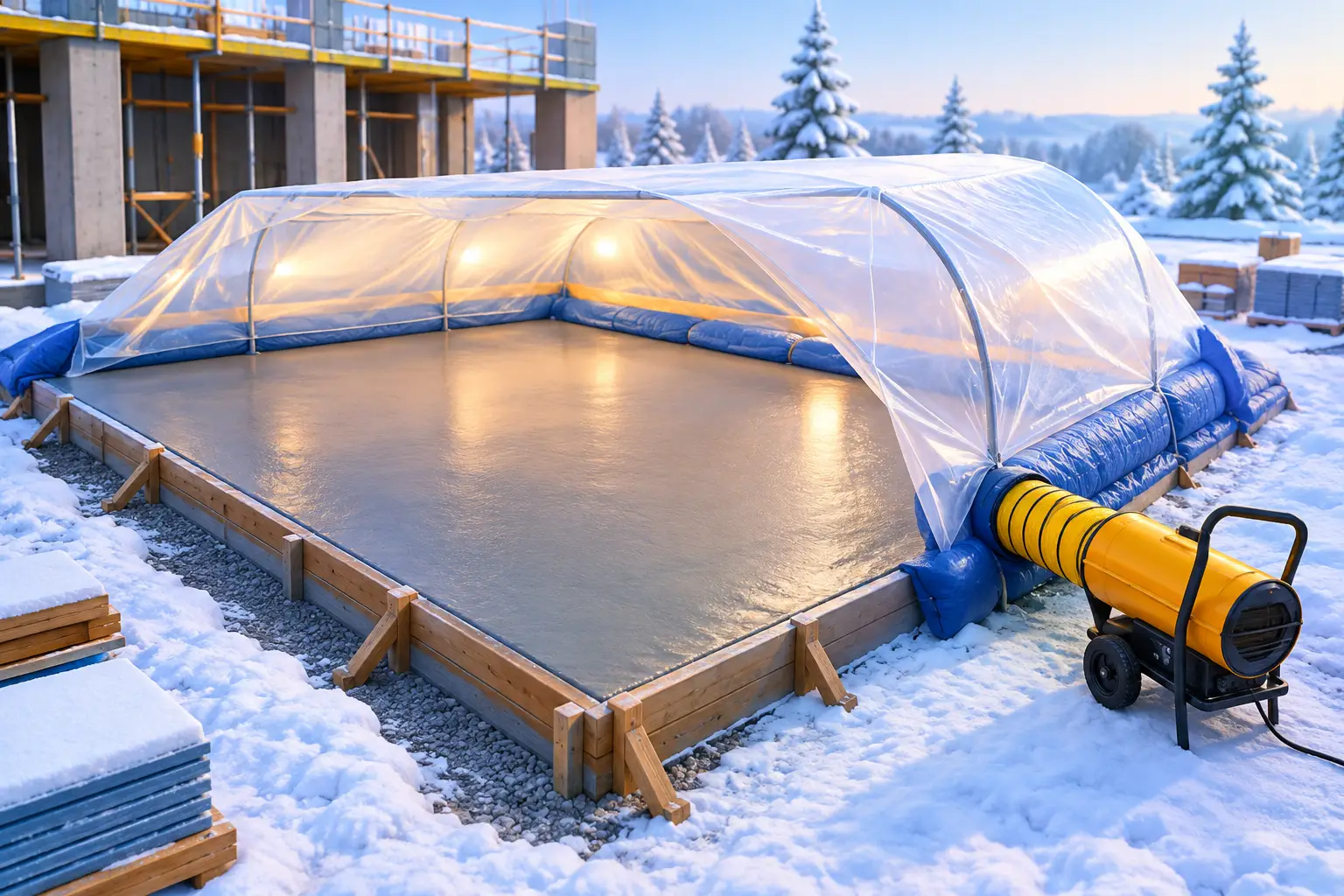
Blankets, insulated forms, heated enclosures, warm mix water, and supplemental heat are valuable tools. But they are methods, not proof. A placement can remain above a minimum temperature while still gaining strength more slowly than the schedule requires. It can also develop excessive internal heat or harmful thermal gradients if heat is added without understanding the concrete's response.
Effective cold weather concrete curing starts with a plan that addresses three questions before the trucks arrive:
- What temperature range must the concrete maintain, and for how long?
- What in-place strength is required before stripping, loading, opening, or advancing work?
- Where are the locations most likely to cool too quickly or develop problematic temperature differences?
Those answers vary by element. A pavement slab exposed to wind deserves a different strategy than a large mat foundation, a post-tensioned deck, or a precast member in a controlled plant environment. The right plan considers section thickness, cementitious materials, admixtures, starting concrete temperature, ambient forecast, formwork, insulation, and the next scheduled construction activity.
Measure concrete temperature where it matters
Air temperature is a planning input. It is not a reliable proxy for concrete temperature.
Embedded sensors provide the temperature history inside the placement, where hydration and strength development are occurring. For a critical pour, sensor locations should represent the controlling conditions rather than the most convenient locations. That often means placing sensors near exposed edges, corners, thin sections, anticipated cold spots, and the core of thicker elements where internal temperature can remain elevated.
This is also how teams identify thermal gradients. The core of a large placement may stay warm while the surface cools rapidly. If the differential exceeds project limits, cracking risk can increase even when the average concrete temperature appears acceptable. Conversely, a thin slab may reveal that insulating protection is not holding heat through the overnight low.
Real-time or frequently updated readings allow the team to act while there is still time to protect the placement. Add insulation, adjust enclosure heat, delay removal of protection, or change the timing of follow-on work based on measured conditions. That is a more defensible workflow than discovering a problem at the next morning's walk-through.
Use maturity to connect temperature history to strength
Temperature alone tells only part of the story. ASTM C1074 concrete maturity testing uses the concrete's time-temperature history to estimate strength development, provided the project has established an approved strength-maturity relationship for the mix.
That distinction matters. Maturity is not a generic temperature-to-strength shortcut. It must be calibrated using the actual concrete mixture and laboratory strength data under the project testing program. Once that relationship is established, in-place temperature data can be converted into maturity information and estimated in-place strength.
For winter work, this gives field teams a practical answer to the question that affects the schedule: has this specific placement reached the required strength yet? Instead of waiting for a standard-age cylinder break or extending protection solely because the calendar says so, the team can evaluate verified in-place curing history.
Maturity does not eliminate cylinders in every situation, and project specifications still govern. Verification testing, acceptance testing, and owner requirements may continue to require cylinder samples. But a well-executed maturity program can reduce unnecessary cylinder testing and provide earlier visibility into whether the placement is tracking toward its required strength.
Protection should respond to the pour, not the clock
Winter plans often fail at the handoff points: after finishing, during an overnight temperature drop, when a heater runs out of fuel, or when protection is removed because the planned curing duration has elapsed. Those are operational failures as much as material failures.
A better approach is to define action thresholds before placement. For example, the team can establish who receives an alert if concrete temperature approaches a minimum limit, who has authority to add protection, and what maturity or strength threshold is required before stripping forms. The exact values should come from the contract documents, mix design, engineer-of-record requirements, and applicable cold weather procedures.
Monitoring also creates a record of what happened. That record is especially valuable when a placement occurs overnight, at a remote site, or during a rapid weather shift. It documents temperatures, maturity progression, protection duration, and the basis for advancing work. For QA teams, inspectors, and owners, that is far more useful than a verbal confirmation that the concrete was covered.
Build the monitoring plan into the pre-pour meeting
The best time to solve winter curing problems is before concrete arrives. The pre-pour discussion should identify sensor locations, installation responsibility, reporting intervals, alert recipients, backup heat or insulation, and the decision-maker for curing adjustments.
It should also account for the forecast beyond the placement window. A pour made at 45°F may still face a 20°F overnight low, high winds, or a multi-day cold stretch that changes curing duration and strength timing. GPS-specific weather data can help crews anticipate those conditions, but the in-place readings remain the operational truth.
Wake's HardTrack platform is built for this workflow: wireless embedded and reusable sensors can deliver concrete temperature and ASTM C1074 maturity data to the people making field decisions, without exposed rebar wiring or routine trips just to collect readings. The value is not the sensor alone. It is the ability to see the placement, respond quickly, and produce specification-ready documentation from the same data stream.
When winter curing data protects more than concrete
Cold weather monitoring protects the schedule because it prevents both avoidable delay and premature action. If the concrete has reached the required in-place strength, the team has a documented basis to move forward. If it has not, the team can maintain protection and adjust the plan before stripping, loading, or opening creates a larger problem.
That control is particularly valuable on overnight bridge pours, remote infrastructure work, high-volume precast operations, and any project where a missed strength target affects multiple trades. A single unverified assumption can turn a weather event into a schedule event.
The most useful winter curing plan is not the one with the most blankets or the longest contingency period. It is the one that gives the field team timely, defensible information about the concrete they placed - and enough time to act on it.