
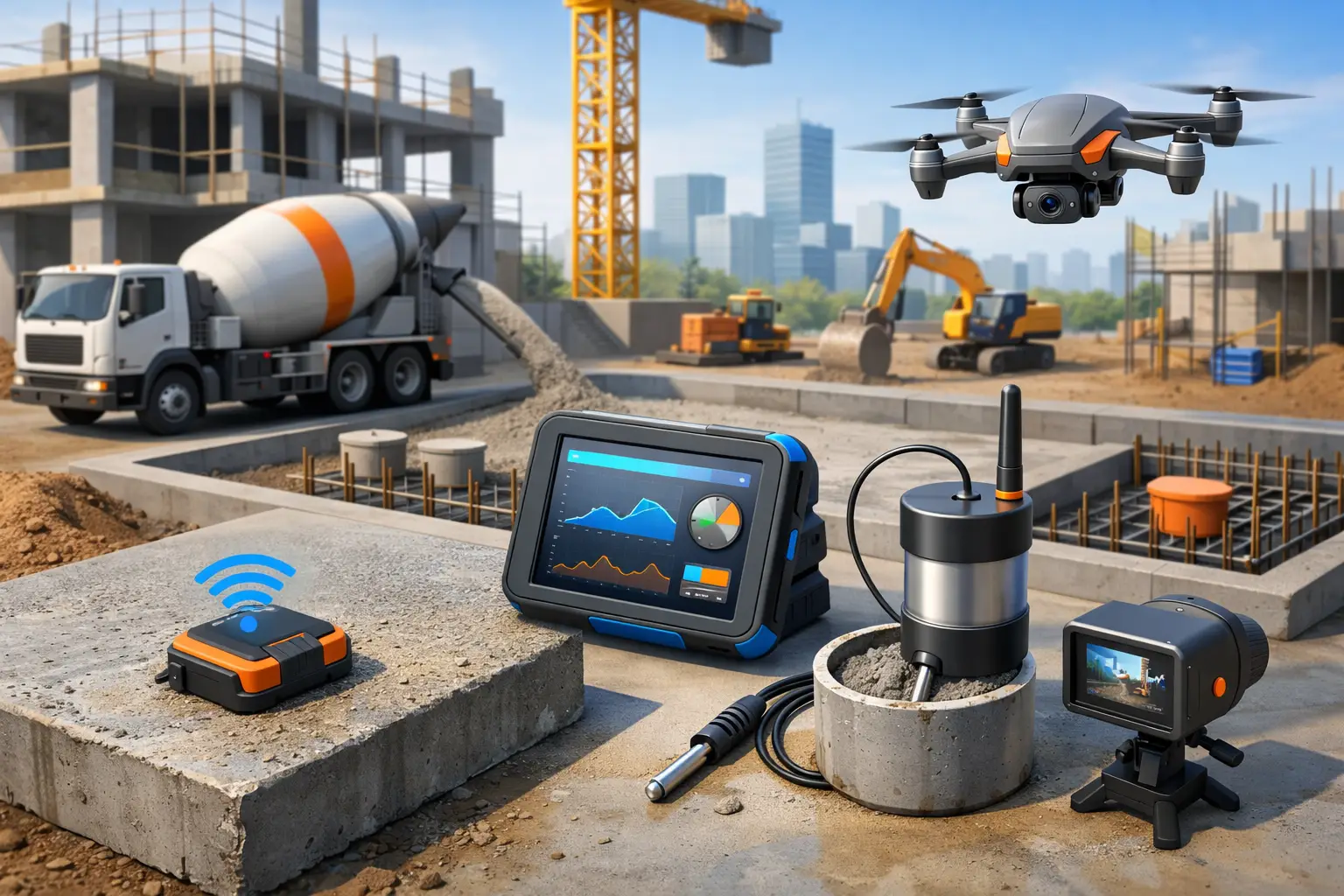
A bridge deck poured at midnight does not wait for the morning testing round. Neither does a precast bed that needs to turn, a mass placement building heat, or a remote foundation pour approaching a critical strength milestone. The best concrete monitoring devices give project teams live, defensible answers about what the concrete is doing in place - without exposing wires, adding unnecessary site visits, or relying only on cylinders stored somewhere other than the structure.
For high-consequence work, selecting a monitoring device is not simply a sensor decision. It is a workflow decision affecting stripping, stressing, opening to traffic, curing adjustments, inspection records, and the confidence to keep the schedule moving.
What the Best Concrete Monitoring Devices Must Do
Concrete monitoring equipment should start with the question that matters in the field: what decision must this data support? Temperature alone may be enough to confirm curing conditions on a routine placement. For strength-based decisions, the system needs a validated ASTM C1074 maturity workflow tied to the project mix's strength-maturity relationship.
The best systems also make data available to the people who need it. A temperature reading trapped in a handheld device or dependent on a technician returning to the pour has limited value when a superintendent, QA manager, owner representative, and inspector need timely visibility. Field hardware, communications, alerts, dashboards, and reports all need to work as one operating system.
A capable deployment should provide accurate internal concrete temperature, capture data at the needed interval, protect the sensor during placement and finishing, and preserve a clear record of where it was installed. It should also support project-specific reporting without creating a separate administrative task at the end of every shift.
Temperature monitoring is not the same as strength verification
Temperature monitoring shows the concrete's thermal history. That can reveal cold-weather curing risk, excessive heat, thermal differential concerns, and whether protection measures are performing as intended. It is valuable information, but temperature alone does not establish in-place compressive strength.
Maturity testing uses time-temperature history and a validated calibration relationship to estimate in-place strength under ASTM C1074. When properly established and documented, maturity data can reduce dependence on destructive cylinder testing and give teams an earlier, more representative basis for operational decisions. The distinction matters when the decision is whether to remove forms, transfer prestress, post-tension, load a member, or open pavement to traffic.
Choose the Device Around the Placement, Not the Catalog
There is no single best device for every concrete project. A sensor that is ideal for an overnight bridge deck may be inefficient for a multi-plant precast operation. The right configuration depends on access, duration, communications, crew workflow, reporting requirements, and the cost of waiting for information.
Embedded wireless sensors for critical placements
Embedded sensors are the strongest choice when teams need internal concrete data from the actual element and do not want exposed rebar wiring across a busy placement. The sensor is tied to reinforcing steel, placed before the pour, and remains protected inside the concrete. That approach suits bridge decks, columns, walls, footings, marine work, tunnels, and other placements where wiring can be damaged, disconnected, or create an avoidable field complication.
For maturity applications, embedded sensors should be paired with an established strength-maturity curve for the mix design. The value is not just seeing a graph. It is receiving a documented indication that the monitored location has reached the strength threshold required for the next operation.
The trade-off is permanence. Embedded sensors are consumed with the placement, so they are best reserved for decisions where in-place data and documentation justify that level of coverage.
Cellular cloud-connected sensors for remote visibility
Cellular devices are built for projects where returning to the site just to collect temperatures makes little operational sense. They send readings to a cloud platform on a defined schedule, allowing stakeholders to review conditions from the office, the trailer, or another jobsite. For remote civil work, long-duration foundations, overnight pours, and projects with dispersed teams, that visibility can eliminate routine data-collection trips.
The strongest cellular systems include connectivity as part of the deployment and clearly show sensor status, location, and recent transmission history. GPS-specific weather context is also useful when air temperatures influence protection decisions or when project teams need to compare concrete response with actual local conditions.
Cellular monitoring does depend on coverage and proper device placement. Before a critical pour, verify signal conditions, reporting intervals, battery or solar configuration, and who receives alerts. Remote data is only useful if the right people are prepared to act on it.
Reusable wireless loggers and portable gateways
Reusable loggers are a practical option for repeated work at precast plants, paving operations, form yards, and large sites where a crew can collect data through a nearby gateway or reader. They can provide strong coverage without consuming a sensor in every placement, particularly where the same equipment is cycled through predictable production workflows.
A portable gateway extends the usefulness of the logger by collecting data wirelessly from a distance. On a large pour, range matters. A system capable of collecting from up to 1,000 feet, depending on site conditions, allows crews to retrieve readings without walking every monitoring location. This is especially valuable when access is restricted, surfaces are not yet safe to enter, or monitoring points are spread across an active operation.
The trade-off is that someone still needs to bring the gateway or reader within communication range unless the configuration includes remote transmission. For plants and repeatable workflows, that is often a sensible exchange. For an isolated pour requiring overnight decisions, cellular reporting may be the better fit.
Handheld readers for direct field checks
Handheld readers fit crews that need immediate access at the point of work. They are useful when a field technician or inspector needs to verify sensor status, collect current readings, or document a check without waiting for a scheduled upload. They can also provide redundancy when connectivity is limited.
A handheld device should not force teams into manual transcription. The best workflow transfers readings into the same project record used for maturity calculations, dashboards, and final reports. Otherwise, the job gains a measurement tool but keeps the paperwork problem.
Evaluate the Monitoring Platform Behind the Hardware
Hardware determines what can be measured. The software platform determines whether the information becomes a decision. When comparing devices, assess the entire chain from installation through final documentation.
First, look for automated alerts tied to meaningful thresholds. An alert should tell the team when temperature is approaching a limit, when maturity reaches a release target, or when a sensor has stopped reporting. Generic notifications create noise. Configurable project alerts direct attention to the conditions that affect quality and schedule.
Next, examine reporting. Inspectors and owners do not need a pile of screenshots at closeout. They need organized, time-stamped documentation that identifies the placement, sensor location, temperature history, maturity result, and applicable strength threshold. Specification-ready Microsoft Excel reporting can be especially effective because it gives QA teams a familiar, auditable deliverable without reformatting data by hand.
Finally, consider stakeholder access. A system that gives the field crew data but leaves the project engineer, testing lab, and owner waiting for emailed updates slows the response cycle. Shared dashboards keep the conversation focused on the same record. That does not eliminate engineering judgment, but it gives every decision-maker a current view of the concrete.
Questions to Ask Before You Deploy
Before choosing equipment, define the decision points for the placement: release from forms, opening to traffic, heat control, curing verification, prestress transfer, or another project-specific requirement. Confirm which locations represent the controlling conditions, not merely the most convenient locations to instrument.
Then verify the maturity program. The mix-specific calibration must be appropriate, the target strength thresholds must be agreed upon, and the installation plan must protect sensors from placement damage. If the project has strict compliance requirements, establish report formats and data-sharing expectations before the first truck arrives.
Also consider practical field factors. Can the device withstand consolidation and finishing? Will the crew know where each sensor belongs? Is remote transmission needed after hours? Does the system reduce cylinder volume without eliminating testing required by the specification? These details determine whether monitoring becomes a dependable process or another task added to the pour checklist.
Wake's HardTrack platform is designed around this full workflow: rugged embedded and reusable monitoring options, cellular and gateway configurations, live dashboards, ASTM C1074 maturity capability, alerts, and documentation built for project records. One platform can support different deployment methods as the placement, access conditions, and decision urgency change.
Put Data Where the Schedule Can Use It
The best concrete monitoring device is the one that gives your team credible in-place information early enough to make the next decision with confidence. On critical work, that means more than collecting temperatures. It means connecting field measurements to curing control, strength verification, accountable documentation, and the operations that cannot wait.
Treat monitoring as part of the placement plan, not a check performed after the pour. When the data is reliable, visible, and tied to clear actions, concrete stops being the uncertainty holding the schedule in place.