
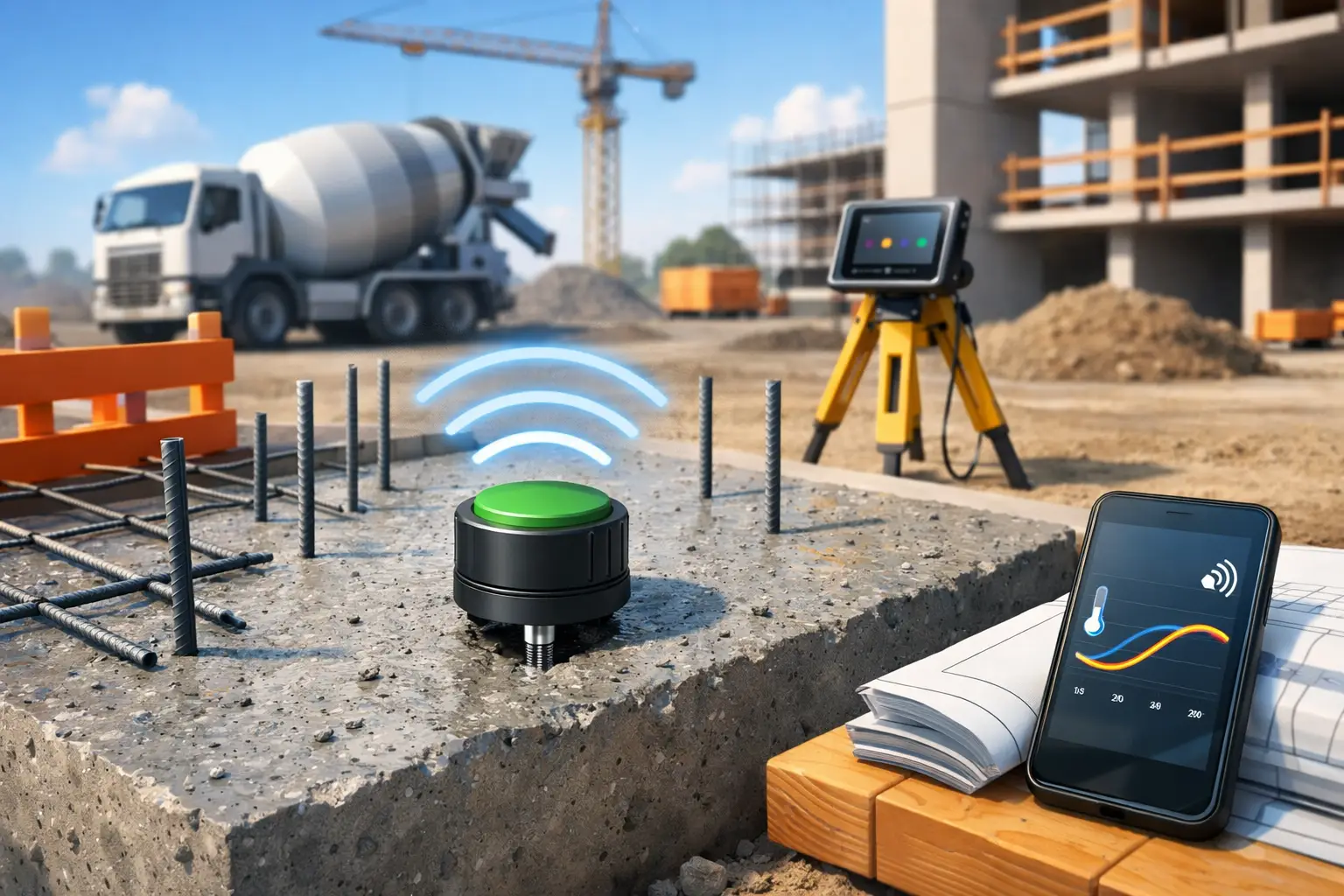
A midnight bridge-deck placement does not wait for the QA team to arrive at sunrise. By then, the concrete may have seen its highest temperatures, the curing record may have gaps, and the decision on when to open the deck may still depend on cylinders that do not fully represent in-place conditions. A wireless concrete temperature sensor changes that workflow by putting live, location-specific curing data in the hands of the people responsible for the pour.
For concrete teams working on schedule-sensitive, specification-driven projects, temperature monitoring is not just a recordkeeping exercise. It is how the team verifies curing conditions, evaluates maturity, responds to heat or cold risk, and documents the basis for critical construction decisions.
What a Wireless Concrete Temperature Sensor Measures
A wireless concrete temperature sensor is embedded in fresh concrete or placed at the required monitoring location before or during placement. It records concrete temperature at scheduled intervals and transmits or stores that data for review. Depending on the deployment, data may reach a cloud dashboard through cellular connectivity, travel from reusable loggers through a nearby gateway, or be collected with a handheld reader.
The value is not simply knowing the current temperature. Temperature history drives concrete maturity calculations under ASTM C1074 when the project has established a valid maturity-strength relationship. That allows the team to estimate in-place strength based on the concrete actually placed in the structure, rather than relying only on companion cylinders cured under different conditions.
This distinction matters on a cold-weather wall pour, a mass concrete foundation, a precast bed, or a paving project with a narrow opening window. Concrete in the structure can cure differently from cylinders in a field box or laboratory. A sensor gives the team evidence from the placement itself.
Why Wireless Monitoring Changes the Jobsite Workflow
Traditional wired systems can provide useful data, but exposed wires introduce jobsite problems. Leads can be cut, pulled, buried, damaged during finishing, or left vulnerable around traffic and formwork. Wireless embedded sensors remove that exposed connection point and let crews monitor without returning to the placement to connect equipment.
That reduction in site visits has practical consequences. A superintendent can check an overnight placement before mobilizing staff. A QA manager can see whether temperatures are approaching project limits. An owner representative or inspector can review the same time-stamped record without waiting for someone to assemble screenshots, field notes, and handwritten logs.
For remote work, connectivity is often the deciding factor. A project may need a cellular cloud-connected sensor that reports from a rural bridge site, a portable gateway that collects data across a large placement, or reusable wireless loggers for a precast operation where monitoring points change every day. One method does not fit every project. The right deployment depends on placement size, access, power, communications coverage, reporting requirements, and whether the sensor will remain embedded or be reused.
Live data supports faster decisions
Concrete decisions often have a cost clock attached. Delaying form removal, post-tensioning, loading, saw cutting, or opening to traffic can affect crews, equipment, lane closures, and downstream trades. Moving too soon creates a far more serious risk.
Live temperature and maturity data help teams act at the earliest defensible point. The word defensible matters. A decision should be supported by an approved maturity curve, project-specific acceptance criteria, calibration records where required, and a report that clearly identifies the sensor, placement, timing, and results. Monitoring technology does not replace engineering judgment or project specifications. It gives that judgment better field evidence.
Alerts catch problems before they become claims
Temperature can move outside the expected range quickly. A rapid temperature rise may signal a concern in mass concrete. Low early-age temperatures may slow strength gain and threaten a planned operation. A missing transmission can indicate a device issue that should be addressed before the data record is compromised.
Automated alerts allow the right people to respond while there is still time to adjust insulation, heating, cooling measures, curing protection, or the work plan. The most useful systems let teams define alert thresholds around the project requirements instead of forcing every job into a generic setting.
Using Sensor Data for ASTM C1074 Maturity Testing
ASTM C1074 provides the framework for estimating concrete strength from the temperature history of the concrete. The standard does not say that any temperature sensor automatically proves strength. A maturity program begins with the concrete mixture and a strength-maturity relationship developed through testing.
Once that relationship is established, the sensor captures the time-temperature data used to calculate a maturity index. The project team then compares that index with the approved strength-maturity curve to estimate in-place strength. This can reduce reliance on routine cylinder breaks for operational decisions, though cylinders and other testing may still be required by the specification, owner, engineer, or agency.
A sound program requires discipline in a few areas. The sensor must be placed where it represents the condition being evaluated. The correct mix design and maturity relationship must be assigned to the placement. The system clock, reporting intervals, and data retention need to support the project record. Most importantly, the team must know which decisions maturity is authorized to support.
For example, a maturity result may support a contractor's formwork removal decision when approved by the project requirements. It may not replace required acceptance cylinders unless the governing specification allows it. The operational benefit comes from using the data correctly, not from treating maturity as a shortcut around quality control.
Where Sensor Placement Makes or Breaks the Record
A sensor only reports the conditions at its location. That sounds obvious, yet poor placement is one of the fastest ways to create data that is technically accurate but operationally unhelpful.
In a bridge deck, the team may need to understand conditions near the top mat, near an edge, or at a location expected to cool faster. In a thick footing or pier cap, the critical concern may be peak internal temperature and the difference between core and surface temperatures. In precast, the placement strategy may focus on representative product zones and the curing environment that governs release strength.
Before the pour, the team should define the question each sensor is meant to answer. Is it confirming strength development for opening? Tracking thermal control? Verifying cold-weather protection? Creating a permanent compliance record? Sensor locations, quantities, and reporting rules should follow those objectives.
Weather data adds jobsite context
Concrete temperatures do not exist in isolation. Air temperature, wind, solar exposure, and changing weather affect the placement, especially near exposed surfaces. Jobsite-specific National Weather Service data can provide context alongside internal concrete readings, helping teams understand why temperatures changed and whether curing protection is performing as expected.
Weather data is context, not a substitute for concrete data. An ambient reading cannot tell a team what is happening at the center of a thick placement. Used together, however, the two records support a more complete curing narrative.
What to Look for in a Monitoring System
The best system is the one crews can deploy correctly under real jobsite conditions. Evaluate hardware durability, battery or solar strategy, communication range, cellular availability, read reliability, and whether the device is appropriate for embedded or reusable use. A sensor that works well in a controlled demonstration but creates installation friction during a night pour will not deliver its promised value.
Also evaluate the reporting path. Field teams need a clear view of current conditions. QA personnel need traceable records. Owners and inspectors may need a specification-ready report in a familiar format, including Microsoft Excel. The platform should make it easy to identify the placement, sensor location, mix, maturity curve, alert history, and measured results without rebuilding the record by hand.
HardTrack by Wake, Inc. is built around that field reality: wireless deployment options for different concrete operations, live data access, automated alerts, and reporting designed for project documentation. The objective is straightforward - make the concrete talk early enough for the team to act.
A wireless sensor is most valuable when it becomes part of the pour plan, not an afterthought installed after questions arise. Put the monitoring plan in place before placement, assign responsibility for reviewing alerts and maturity results, and let the data guide the next critical move with evidence from the concrete that is actually carrying the project.