
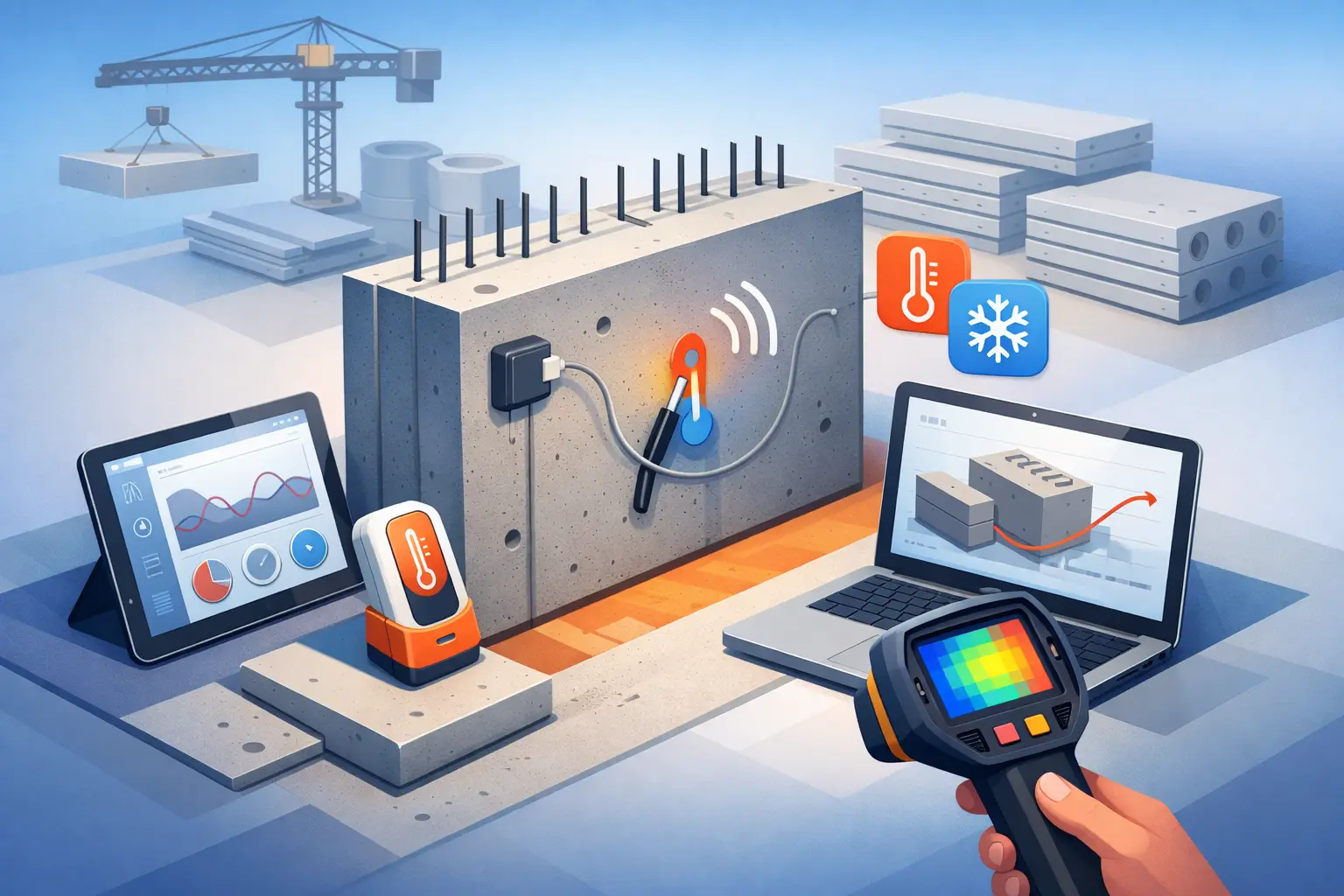
A precast bed can look ready long before the concrete has developed the strength required for detensioning, stripping, handling, or shipment. That gap is where schedules slip and risk enters the process. Precast concrete temperature monitoring gives plant teams a direct view of the curing conditions inside the member, so decisions are based on in-place data rather than elapsed time, assumptions, or a cylinder that has not experienced the same thermal history.
For high-volume precast operations, the value is not just a temperature graph. It is control over bed turnover, steam curing, strength verification, quality documentation, and labor planning. When every hour matters, reliable monitoring turns curing from a waiting period into a managed production step.
Why precast curing needs closer control
Precast concrete is often subjected to conditions that differ sharply from conventional cast-in-place work. Members may be placed in heated enclosures, under insulated tarps, in enclosed beds, or outdoors through changing weather. Steam application, member geometry, mix design, cement type, supplementary materials, and ambient conditions all affect the temperature profile and strength development.
A plant can have a consistent curing program and still see meaningful variation between beds. A thick wall panel retains heat differently than a slender prestressed member. A cold mold, a delayed cover installation, or an uneven steam distribution pattern can change early-age performance. The concrete does not care what the cure schedule said it should receive. It responds to the temperature it actually experienced.
That is the operating case for embedded monitoring. A sensor placed in the member records the thermal history where it matters, helping the team confirm whether curing is progressing as expected and identify exceptions before they become production problems.
What temperature data can tell a precast plant
Temperature alone does not establish compressive strength. But paired with a validated ASTM C1074 maturity relationship, temperature history becomes a practical method for estimating in-place strength. This gives QA teams and production managers current information to support release decisions.
The key distinction is between a monitoring program that collects data and one that supports a workflow. A useful program answers practical questions: Is the bed ready to strip? Has the member reached detensioning strength? Did the overnight cure stay within the target range? Which units need additional time? Is the curing cycle producing repeatable results across shifts and seasons?
Temperature records also reveal process conditions that cylinders may miss. Field-cured cylinders can be valuable checks, but they require sampling, storage, transport, handling, and testing. They can also experience a curing environment unlike the member in the bed. Maturity monitoring is not a reason to abandon quality control discipline. It is a way to reduce unnecessary destructive testing while improving visibility into the concrete that will actually be lifted, stressed, moved, and delivered.
Precast concrete temperature monitoring for release decisions
The most effective monitoring programs start with the decision that data needs to support. For a prestressed operation, that may be a detensioning threshold. For architectural panels, it may be stripping and safe handling strength. For utility products or structural components, it may be a release strength tied to the plant's production sequence and customer requirements.
Once the decision threshold is defined, the team establishes a maturity calibration for the approved mix design in accordance with ASTM C1074. That relationship links maturity index to measured strength from a controlled test program. The resulting curve is specific to the mix and its materials. It should not be borrowed from a similar mix or treated as permanent when materials, proportions, admixtures, or production methods change.
Embedded sensors are then positioned to represent the member and curing environment. Placement should be purposeful. A sensor near the center of a thick element may capture heat retention that an edge location will not. A member exposed to a cooler end of a curing enclosure may need its own verification point. For repetitive production, the goal is not to instrument every piece forever. It is to monitor enough representative units to validate the process and quickly detect when it drifts.
With a calibrated curve and defensible sensor placement, the team can view estimated in-place strength as the cure progresses. Instead of waiting for a scheduled break time, supervisors can release a bed when the concrete has reached the required threshold. If conditions slow development, the data supports the opposite decision: hold the bed until the strength is there. Both outcomes protect the operation.
Monitor the temperature range, not only the strength target
A maturity result may show that strength is developing, but the temperature record still deserves review. Excessive peak temperatures can contribute to durability concerns and inconsistent performance, especially in thicker sections or aggressive heat-cure cycles. Temperatures that rise too slowly can signal a steam delivery, cover, mix, or batch-temperature issue.
The acceptable range depends on the product, mix, specification, and plant quality plan. There is no universal cure temperature that fits every precast operation. What matters is establishing limits that match the engineered product and using live data to confirm the actual cycle stays within them.
Build monitoring into the plant workflow
The technology needs to fit the pace of production. If retrieving data requires technicians to enter every curing area, connect leads, or manually transcribe readings, monitoring becomes another task that gets skipped during a busy shift. Wireless systems remove much of that friction.
Rugged embedded sensors can remain with the member during its early-age cure, while reusable wireless loggers and portable readers can serve plants with changing layouts or multiple cure locations. Cellular-connected configurations extend visibility beyond the plant floor, allowing QA managers, project engineers, and owners to review live data without waiting for a file transfer or site visit.
Wake's HardTrack platform is built around this field reality: get the data from the concrete to the people making the decision, without exposed rebar wiring or a complicated retrieval process. The right configuration depends on the plant's layout, volume, connectivity, and documentation requirements.
A practical workflow typically includes four operating steps:
- Define the release decisions, required strengths, temperature limits, and responsible approvers for each product family.
- Develop and maintain ASTM C1074 maturity calibrations for the mix designs used in production.
- Place sensors at representative locations, verify data transmission, and set alerts for missed targets or temperature exceptions.
- Export specification-ready records that connect the member, mix, curing history, maturity result, and release decision.
The monitoring system should complement existing batch, QC, and production records rather than create a separate information silo. When data is organized by bed, pour date, mix, product type, and member identification, it is useful months later during an audit, customer question, or internal root-cause review.
Alerts prevent late discoveries
The best time to learn that a cure cycle is outside target is when there is still time to correct it. Automated alerts can notify the right person when a temperature reaches a limit, fails to rise as expected, or when maturity reaches a release threshold. That is especially valuable for overnight cures, weekend production, and plants where one QA manager supports several lines.
Alert settings need judgment. Too many notifications create noise and get ignored. Too few leave the team reacting after a problem has already affected the schedule. Start with events tied to real actions: a low-temperature condition that calls for checking the enclosure, a high-temperature condition requiring a cure adjustment, or a strength threshold that permits the next production step.
Remote access changes the response window. A production manager can confirm a bed's status before arriving at the plant. QA can review an exception while it is occurring. Inspectors can receive documented records without waiting for paper logs to be assembled. That speed matters when cranes, crews, shipping slots, and customer commitments are all tied to the release schedule.
Documentation is part of the product
Precast producers are judged on more than output. They must demonstrate that products met specified requirements using records that are clear, complete, and defensible. A temperature-monitoring report should show more than a final strength estimate. It should identify the monitored placement, sensor, time history, maturity calculation, calibration basis, and relevant release event.
Microsoft Excel reporting remains useful because it can move easily through project teams, owners, consultants, and inspectors. The advantage is not the file format itself. It is having consistent, specification-ready information that does not require someone to reconstruct the story from handwritten logs, disconnected downloads, and laboratory tickets.
For plants producing DOT, transit, utility, bridge, marine, or other high-consequence components, this documentation can become a meaningful differentiator. It demonstrates process control while giving customers confidence that release decisions were supported by actual curing data.
Start with the bottleneck that costs the most
Not every precast operation needs the same deployment. A small plant may begin by monitoring the product line where slow strength gain most often delays stripping. A multi-plant producer may prioritize high-volume beds, remote yards, or products with demanding owner documentation. A prestressed facility may focus first on detensioning decisions and thermal uniformity during accelerated curing.
The right first application is usually the one where uncertainty is expensive. Monitor the bed that holds up crews, causes recurring cylinder breaks, creates shipping risk, or requires the most calls between production and QA. Prove the workflow there, then expand with a clear understanding of the time saved, testing reduced, and exceptions caught.
Concrete will continue to cure whether the team is watching or not. The advantage comes from knowing what is happening inside the member early enough to act on it. That is how a precast plant keeps quality documented, release decisions defensible, and the next bed moving.