
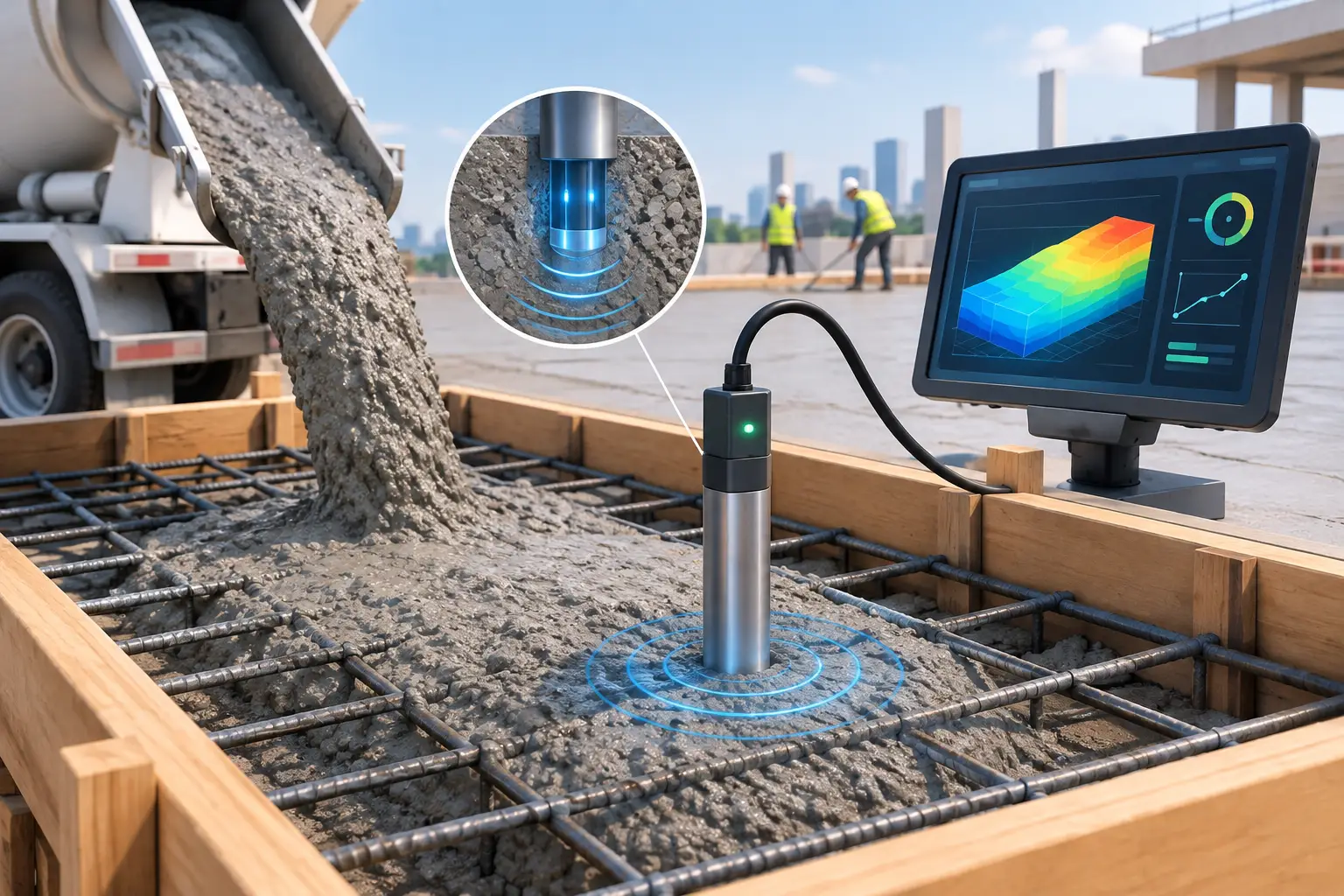
A maturity result is only as credible as the temperature history behind it. Maturity sensor accuracy is not simply a question of whether a device records a temperature. It is the combined accuracy of the sensor, its placement in the concrete, the maturity calibration, and the workflow used to turn temperature data into an in-place strength estimate.
For a bridge deck pour, precast member, mass foundation, or elevated slab, that distinction matters. A temperature record that does not represent the concrete at the decision point can lead to an early form removal decision, a missed strength target, unnecessary cylinder breaks, or a documentation dispute when the schedule is already under pressure.
What Maturity Sensor Accuracy Actually Means
Concrete maturity testing under ASTM C1074 uses the time-temperature history of a concrete mixture to estimate its in-place strength. The sensor supplies the temperature record. The maturity method applies the project’s established relationship between maturity and strength.
That means a sensor can be highly accurate from an instrumentation standpoint while the final strength estimate is still wrong for the application. If the sensor is installed in the wrong location, if the wrong calibration curve is selected, or if the mix changes without re-establishing the relationship, the reported maturity may not represent the concrete condition that matters.
Field teams should separate two questions:
- Is the sensor measuring temperature correctly?
- Does that measured temperature history support a valid strength estimate for this specific concrete and location?
The first is a hardware and verification question. The second is an ASTM C1074 program question. Both must be right before maturity data can replace or reduce reliance on conventional cylinder testing.
The Four Controls Behind Reliable Results
1. Sensor placement must match the decision
Concrete does not cure at one uniform temperature. The center of a thick footing may generate substantial heat while the surface loses heat rapidly to cold air, wind, formwork, or a chilled subgrade. A sensor near a heated enclosure may not reflect conditions at an exposed corner. A sensor placed in a congested reinforcing zone may behave differently than one in the bulk concrete.
Install the sensor where the project team needs to make a decision. For strength-based decisions, that may mean the location expected to develop strength most slowly. For thermal control, it may mean monitoring the warmest interior zone and the coolest surface region to understand the temperature differential.
The right location depends on the placement. A thin slab-on-grade, a post-tensioned deck, and a heavily insulated mass concrete placement should not receive the same monitoring layout. The goal is not to collect the most temperatures. It is to collect the temperatures that answer the actual field question.
Sensor embedment also matters. The sensing point should be fully surrounded by representative concrete, protected from movement during consolidation and finishing, and located away from conditions that create a misleading local reading. That includes unintended contact with forms, voids, ice, or materials that do not represent the concrete mass being evaluated.
2. The maturity calibration must match the mix
ASTM C1074 does not provide a universal maturity-to-strength curve. The relationship must be established for the concrete mixture used on the project. Cement type, supplementary cementitious materials, admixtures, aggregate sources, water-cementitious ratio, and temperature sensitivity can all affect strength development.
A curve developed for one mix should not be assumed valid for a revised mix design, a changed cement source, or a materially different admixture package. Even when the fresh concrete looks familiar, the rate at which strength develops may not be.
This is where teams can make an avoidable mistake: treating maturity as a temperature-monitoring tool with a strength number attached. Temperature monitoring is valuable on its own, but strength estimation depends on a documented calibration relationship. The strength curve, datum temperature or equivalent-age inputs, and test-age data need to align with the method being used.
When specifications require maturity testing, establish the calibration early enough that it does not become a pre-pour scramble. Review the planned mix, acceptance criteria, curing assumptions, and required documentation with the testing laboratory and project stakeholders before the critical placement begins.
3. Data collection has to survive jobsite reality
An accurate sensor does little good if the record is incomplete. Dead batteries, damaged leads, missed manual readings, disconnected hardware, or data that never reaches the project team create blind spots precisely when a strength decision is needed.
This is why wireless maturity monitoring changes more than the method of collecting temperatures. It changes the operating model. Embedded sensors and wireless loggers can capture the temperature history continuously while field personnel focus on placement, finishing, protection, and the next shift. Cellular-connected systems can provide live visibility without requiring someone to return to a remote pour just to retrieve a reading.
Data interval matters as well. Concrete temperature can change quickly after placement, especially in small sections, cold-weather work, hot-weather conditions, and stripping or enclosure transitions. Logging at intervals that are too long can flatten meaningful changes in the temperature history. Logging at practical, consistent intervals preserves a defensible record without creating unnecessary field work.
The full record should show more than a final strength estimate. For quality and compliance purposes, teams need traceable placement identification, timestamps, sensor locations, temperature history, maturity calculations, and a clear association with the approved calibration. That is the difference between a useful number in the field and documentation an owner, inspector, or QA manager can evaluate later.
4. The system needs verification, not blind trust
Electronic temperature sensors are manufactured instruments. Their performance should be understood, verified, and managed under a documented quality process. Use equipment with known accuracy specifications, follow the manufacturer’s handling and installation procedures, and confirm that the reported data is plausible for the placement conditions.
A quick field reasonableness check is often valuable. If one sensor reports a temperature sharply different from comparable nearby locations, do not assume the concrete is behaving unusually until placement depth, location, installation, and sensor identification have been reviewed. Anomalies may reveal a genuine thermal issue, but they can also reveal a sensor installed near an unrepresentative boundary condition.
Redundancy is appropriate when the cost of a wrong decision is high. On a major structural placement, installing sensors at more than one critical location can distinguish a local condition from a broader curing trend. It also gives the team a backup record if a location is damaged during finishing, stripping, or subsequent construction activity.
Common Reasons Maturity Data Loses Credibility
The most common failure is using a valid sensor in an invalid application. A temperature sensor installed near the top of a member cannot automatically support a decision about strength at the core. Likewise, a maturity curve developed under one curing condition cannot be treated as a blanket guarantee for every production variable.
Another issue is weak chain-of-custody documentation. If a report cannot clearly identify which sensor was installed in which element, when it began recording, and which calibration applies, the project team may have useful operational information but not a record that resolves an inspection question.
Manual workflows also introduce risk. Handwritten readings can be missed during nights, weekends, weather events, or shift changes. Data transcription can introduce errors. And when readings depend on routine site visits, a remote project may spend time and labor collecting information that could be available automatically.
The answer is not to eliminate engineering judgment. It is to give that judgment continuous, location-specific data and a reporting trail that holds up after the pour.
Building a Defensible Monitoring Program
Start with the decision that maturity monitoring is meant to support: form removal, post-tensioning, opening to traffic, stressing, lifting, curing adjustment, or verification of in-place strength. Then identify the concrete location most relevant to that decision and deploy sensors accordingly.
Next, confirm the ASTM C1074 calibration for the production mix and establish who owns each part of the process. The concrete producer, testing laboratory, contractor, and QA team may all contribute, but responsibility for mix verification, installation, review, and report acceptance should be clear before placement day.
Finally, use a monitoring platform that keeps the data accessible and organized. Wake’s HardTrack platform is built for this workflow, combining embedded and wireless monitoring options with live project visibility, automated alerts, and specification-ready reporting. The practical advantage is control: fewer unnecessary site visits, faster strength decisions, and a documented record that stays tied to the work.
Maturity monitoring earns its value when the project team can act on the data with confidence. Put the sensor where the decision lives, validate the strength relationship, protect the temperature record, and make every result easy to defend when the job is moving fastest.