
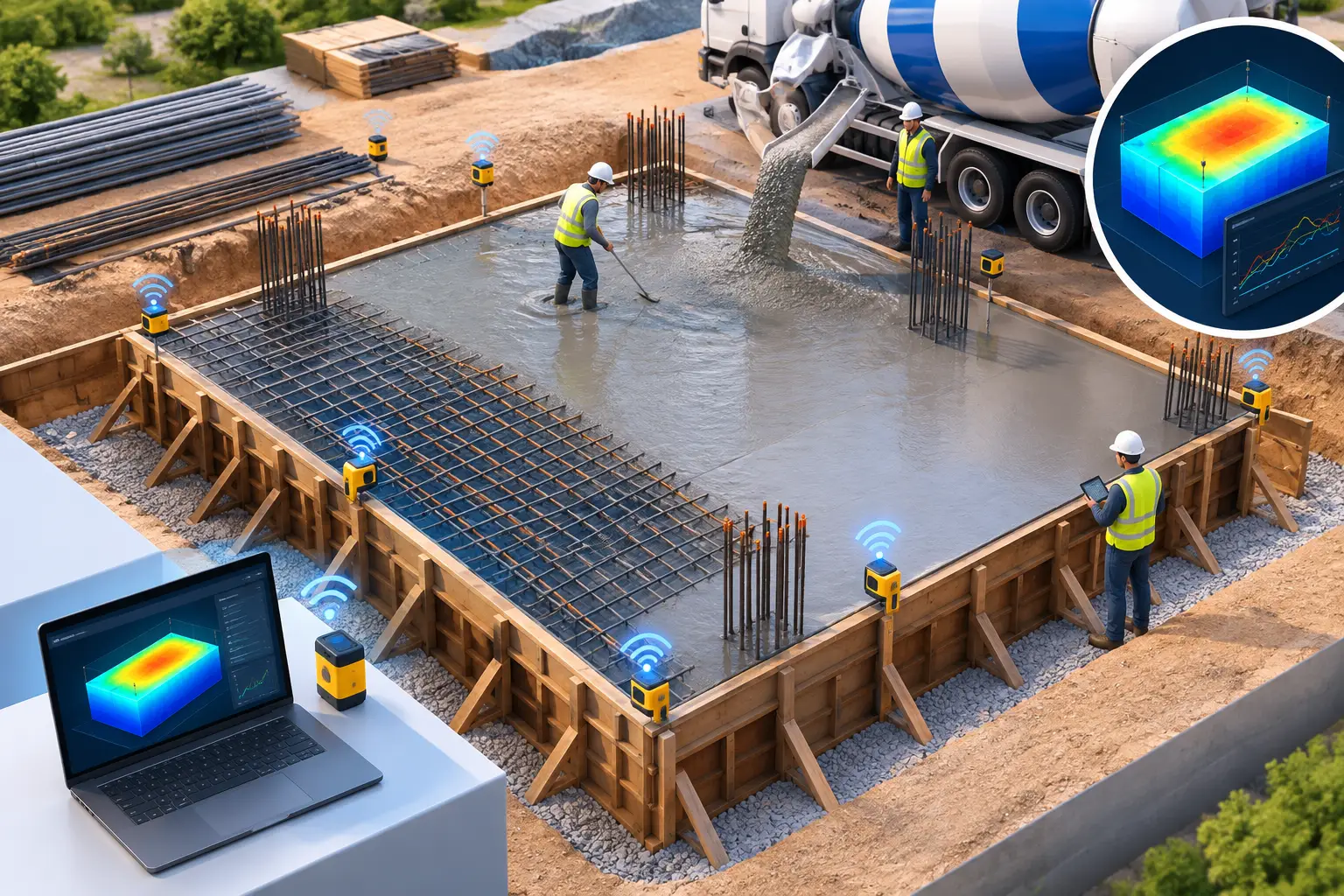
A mass concrete monitoring guide should begin before the first truck arrives. Once a large placement is underway, the concrete’s internal temperature can rise quickly, while its surface responds to cold air, wind, forms, insulation, and curing practices. If the temperature differential becomes too great, thermal cracking can compromise durability, trigger corrective work, and put a critical schedule at risk.
Mass concrete is not defined by yardage alone. It is concrete where the member dimensions, cementitious system, placement temperature, and environmental conditions create a meaningful risk of excessive internal heat or damaging temperature gradients. A bridge pier cap, thick mat foundation, dam element, tunnel invert, marine footing, or heavily reinforced transfer structure may all require a monitoring plan. The governing question is straightforward: can the project team verify what the concrete is doing inside the placement, not just what conditions look like on the surface?
Start the Monitoring Plan Before Placement
A useful plan connects the mix design, member geometry, weather forecast, curing method, structural release criteria, and specification limits. Monitoring is not just a data collection task assigned after the pour. It is a control process that gives the superintendent, QA/QC team, engineer, and owner timely information to make decisions.
Review the project specifications first. They may establish a maximum internal concrete temperature, a maximum core-to-surface differential, required monitoring duration, reporting intervals, and actions required when limits are approached. Do not assume a common industry limit applies automatically. For example, a 35°F differential is frequently used as a planning reference, but the project specification and engineer of record control the acceptance criteria. Maximum temperature limits also vary based on durability requirements, materials, and owner standards.
The pre-pour conversation should define who receives alerts, who has authority to adjust curing measures, and how data will be documented. That matters during an overnight placement, when a response delayed by several hours can be the difference between maintaining stable conditions and chasing a preventable problem.
Build a Sensor Layout Around Heat Flow
Temperature sensors should be located to show how heat moves through the member. A single sensor in the warmest area can confirm peak internal temperature, but it cannot show whether the surface is cooling too quickly. Likewise, a surface sensor alone does not reveal the core temperature driving the differential.
For many placements, the minimum useful arrangement includes a core location and a near-surface location at the same section. The core sensor is placed where heat is expected to accumulate, often near the center of the mass or another thermally critical zone identified by the engineer. The near-surface sensor should be positioned close enough to represent surface behavior without being affected by direct exposure or installation artifacts. Ambient conditions should also be captured when they influence curing decisions.
Large or irregular placements may need multiple monitoring sections. Place additional sensors near cold joints, corners, changes in thickness, restraint points, high-cement zones, and areas expected to receive different insulation or formwork treatment. For a long mat or pier cap, monitoring one end does not prove conditions at the other. Sensor density should follow the risk profile of the placement, not a one-size-fits-all template.
What to Track During a Mass Concrete Placement
The most useful readings are internal temperature, near-surface temperature, ambient temperature, temperature differential, and the rate at which temperatures are rising or falling. Together, these values tell the field team whether hydration heat is building as expected and whether the curing system is protecting the concrete during cooling.
Peak temperature matters because elevated temperatures can affect long-term performance and may exceed project limits. The differential between core and surface matters because the interior and exterior do not expand and contract at the same rate. When the surface cools much faster than the core, tensile stresses can develop near the exterior. The risk depends on concrete properties, restraint, member geometry, and the thermal history of the placement, which is why the engineer’s criteria should guide the response.
Trend data is often more valuable than a single reading. A core temperature of 145°F may be acceptable under a project’s limit, but a rapid upward trend may signal that the peak is still hours away. A differential below the limit may look acceptable at noon, then climb after sunset as air temperature drops. Live data gives the team time to add insulation, retain forms, adjust cooling measures, or extend curing before conditions move outside the allowed range.
Automated alerts should be set below the actual specification limits. This creates response time. A warning threshold can prompt a field check, while a higher action threshold can require a documented corrective measure. Alerts without assigned responsibilities are only notifications. Every project should establish who receives them and what that person is expected to do.
Use Maturity for Strength Decisions, Not Temperature Alone
Temperature monitoring and concrete maturity testing solve related but different problems. Temperature data helps manage thermal behavior. ASTM C1074 maturity testing estimates in-place strength based on the concrete’s time-temperature history and a documented strength relationship for that mix.
For mass concrete, maturity can support decisions about form removal, post-tensioning, traffic opening, load transfer, or other strength-based milestones. It can also reduce reliance on waiting for laboratory cylinders that may not experience the same temperature history as the placement. But maturity is only defensible when the program is set up correctly.
A valid ASTM C1074 approach starts with a strength-maturity relationship developed for the specific concrete mixture. The team must establish the datum temperature and maturity function, install sensors in representative locations, and correlate maturity index values with measured strength. A generic curve from another mix, plant, or material source is not a substitute for calibration.
Mass concrete creates a useful but sometimes misunderstood maturity advantage. The warm core may gain strength faster than standard-cured cylinders because hydration is accelerated. That does not mean every part of the member has reached the same strength. Place maturity sensors where the release decision is most critical, and confirm that the monitored location represents the concrete governing the operation.
Install for Data You Can Defend
A monitoring program fails when its data cannot be traced to a location, time, sensor, and defined acceptance criterion. Before concrete arrives, label each sensor location on a placement drawing and record its depth, orientation, installation time, mix designation, and intended purpose. Protect sensor leads or embedded hardware from vibrator damage, finishing operations, and equipment traffic.
Wireless embedded sensors remove exposed rebar wiring and reduce the risk of damaged leads during placement. Cellular-connected systems can provide remote visibility without sending personnel to a remote bridge deck, dam site, or overnight pour simply to retrieve readings. The right deployment depends on site conditions. A reusable wireless logger and portable gateway may fit a contained jobsite, while a cellular cloud-connected sensor can be the better choice where continuous off-site access is required.
Verification still matters. Confirm that each device is reporting before placement begins, verify the sensor clock and reporting interval, and document any sensor that is moved or replaced. Shorter logging intervals are useful during the first critical hours and during forecasted temperature changes. Longer intervals may be sufficient during stable curing, but the project team should never create gaps large enough to miss a peak or rapid cooling event.
Respond to Trends, Then Preserve the Record
When temperatures approach a limit, the appropriate response depends on the cause. If the surface is cooling too quickly, additional insulation, enclosed curing, delayed form removal, or protection from wind may reduce the differential. If core temperature is rising beyond expectations, the response may involve managing placement temperature, cooling strategies, lift sequencing, or measures established in the approved thermal control plan. Field changes should remain within the engineer-approved procedures.
Do not treat monitoring as a pass-fail exercise at the end of curing. The operational value comes from acting while conditions can still be managed. A live dashboard lets the project team see the same data, while automated reports create a consistent record for inspectors, owners, and closeout files.
The final documentation should show sensor locations, temperature histories, applicable limits, alerts, actions taken, and maturity-based strength results where used. Specification-ready Excel reporting is particularly useful when owners or QA teams require data in a familiar, reviewable format. A system such as Wake’s HardTrack platform helps keep those records connected to the actual placement rather than scattered across field notes, text messages, and manual spreadsheets.
A critical pour does not need more people standing over it with clipboards. It needs reliable information early enough to protect the concrete, the schedule, and the record that proves the work was done right.