
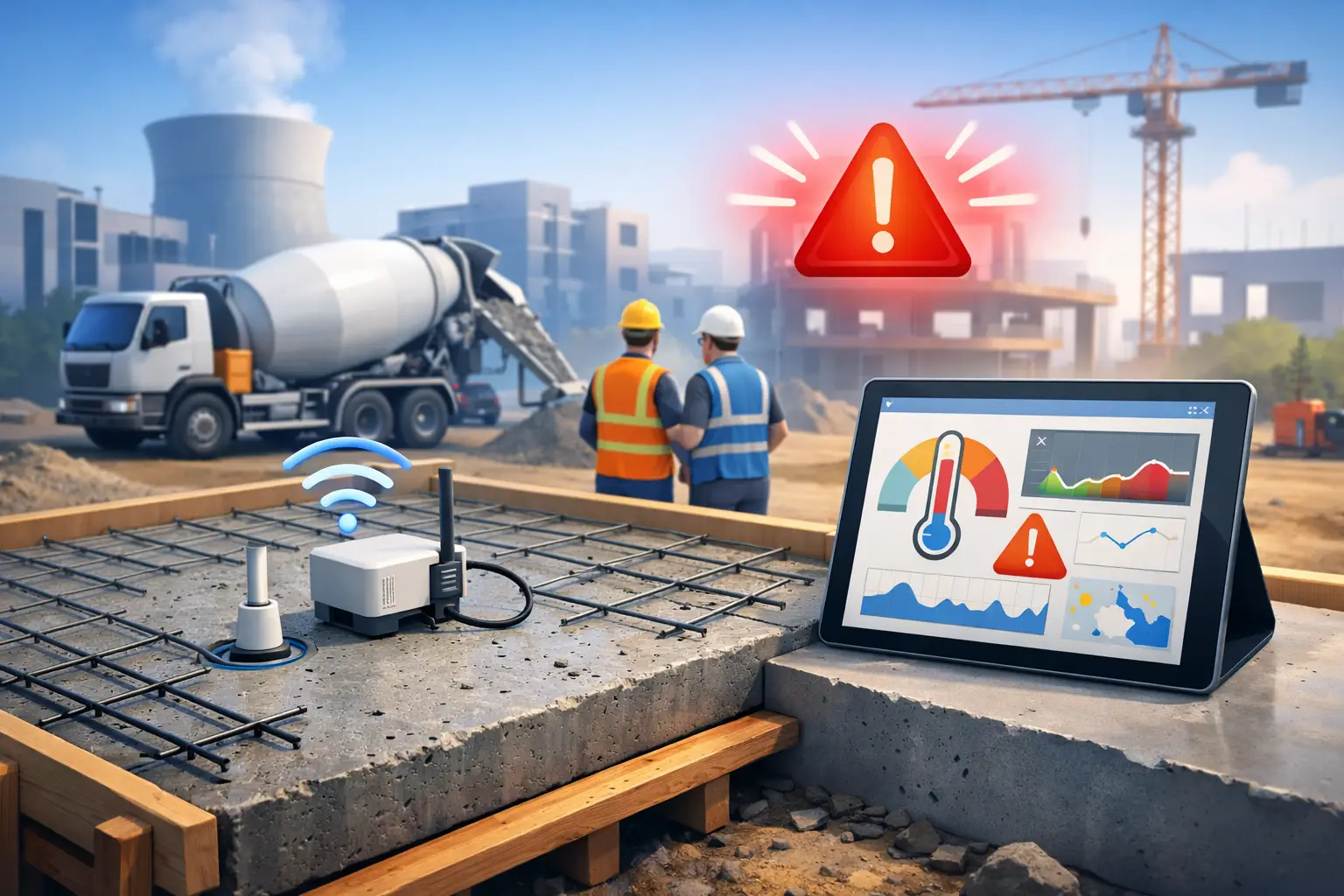
A concrete curing temperature alert system is not a convenience feature on a critical pour. It is an early-warning tool for the hours when concrete can gain strength too slowly, heat up too quickly, or fall outside the curing conditions required by the project specification. When a bridge deck is placed before a cold night, a mass footing is holding heat, or a precast yard is cycling forms around the clock, waiting until the next site visit can turn a manageable condition into a schedule and quality problem.
The right system gives the team live temperature data, clear notifications, and a record that can stand up to review. More than that, it tells the right people when conditions demand action - before the strength schedule, finish quality, durability, or compliance documentation is affected.
Why curing temperature needs active control
Fresh concrete does not respond to ambient weather alone. The temperature inside the placement is affected by cement chemistry, mix design, member size, placement temperature, insulation, curing method, and the heat generated during hydration. A thin slab can cool quickly under wind and falling nighttime temperatures. A large foundation element can retain enough heat to create a significant core-to-surface differential.
That distinction matters because concrete performance is tied to its actual thermal history. If temperatures are too low, hydration slows and in-place strength may not reach the required threshold when the schedule says it should. If temperatures are excessive, particularly in larger placements, teams may face thermal cracking concerns, durability questions, or specification noncompliance.
Manual checks can confirm a condition at one moment. They cannot reliably show what happened between checks, especially overnight, over weekends, or at remote work fronts. A connected alert system changes that workflow from periodic observation to active control.
What a concrete curing temperature alert system should do
A useful monitoring program starts with accurate in-place temperature measurement. Sensors need to be located where the project team can understand the placement's behavior: often near the core, near the surface, at vulnerable edges, or at locations defined in the thermal control plan. The system should collect readings on a set interval and make those readings available without requiring a technician to retrieve every device by hand.
Alerts are the operational layer. Rather than asking a superintendent or QA technician to watch a dashboard all night, the system should issue a notification when a defined condition occurs. That may be a minimum internal temperature, maximum internal temperature, maximum temperature differential, a rapid temperature change, or a communication issue that requires attention.
For high-consequence work, the alert must reach people who can act. That often includes the superintendent, concrete manager, QA/QC lead, project engineer, and testing personnel. The notification should identify the placement, sensor location, measured condition, and time of occurrence. Vague alerts create phone calls and delays. Actionable alerts support a decision at the jobsite.
A complete system also preserves the record. Temperature graphs, sensor histories, placement details, and alert events should be exportable in a format that supports daily reports, owner submittals, and closeout documentation. The best field technology reduces work twice: it helps crews respond in the moment and helps the project defend what happened later.
Temperature alerts are not one-size-fits-all
There is no universal alarm value that fits every concrete placement. Project specifications, mix designs, cementitious materials, member geometry, weather exposure, curing methods, and the engineer's thermal plan all affect the thresholds that should be used.
For example, a cold-weather placement may need an alert when internal temperature approaches the project's minimum curing requirement. The response could include checking enclosure heat, adding insulation, adjusting protection, or extending curing time. A mass concrete placement may need separate high-temperature and differential-temperature alerts, with responses tied to insulation adjustments, cooling measures, or the approved thermal control plan.
The key is to establish thresholds before placement, not after a temperature trend becomes a problem. The monitoring setup should reflect the project plan, and the response responsibilities should be clear to the people receiving alerts.
From temperature data to strength decisions
Temperature monitoring becomes more valuable when it is connected to concrete maturity. Under ASTM C1074, a project can use the concrete's time-temperature history and an established maturity relationship to estimate in-place strength. That gives teams a practical path to make strength-dependent decisions based on the actual concrete in the structure rather than relying only on field-cured cylinders.
This is where a temperature alert system supports schedule control. An alert may show that the placement cooled below the expected range and strength gain is likely to slow. The team can respond early, then use maturity data to verify when the required in-place strength has been achieved for form removal, post-tensioning, opening to traffic, or loading.
Maturity does not eliminate the need for a sound testing program, mix-specific calibration, or project acceptance requirements. It does reduce the guesswork around whether the structure is ready for the next operation. On projects where an extra shift, delayed lane opening, or idle crane time carries real cost, that distinction is substantial.
Build alerts around the jobsite response
A notification has value only when it leads to an appropriate response. Before concrete arrives, the project team should define who receives alerts, who verifies the condition, and what corrective actions are available. This is especially important for overnight pours and geographically dispersed projects, where the person seeing the alert may not be standing beside the placement.
For a cold-weather slab, the response might be to inspect blankets, heaters, enclosure integrity, and surface conditions. For a high-temperature mass placement, it may involve reviewing core and surface trends, confirming insulation placement, and consulting the thermal control plan. The system should provide enough live context that teams are not reacting to a single number in isolation.
Sensor placement deserves the same discipline. One sensor can be adequate for a uniform, lower-risk placement, but it may not capture the critical behavior of a deep wall, large pier cap, or foundation mat. Monitor the locations that answer the actual question: Is the core getting too hot? Is the exposed edge cooling too fast? Has the placement achieved the maturity required for the next step?
Avoid the gaps that weaken monitoring programs
The most common failure is treating remote data as a substitute for a plan. Sensors report conditions. They do not choose thresholds, install insulation, maintain heaters, or approve a strength-related operation. Teams still need defined procedures and qualified decision-makers.
Another gap is relying on ambient weather data as proof of concrete temperature. Forecasts and local weather stations are useful context, particularly when a platform incorporates GPS-specific National Weather Service information, but the concrete itself is the material being cured. In-place sensors provide the record that matters for actual thermal performance.
Communication reliability also deserves attention. Remote sites, large structures, and congested urban projects can challenge wireless transmission. A deployment should match the site: embedded sensors for permanent in-place records, cellular-connected devices where direct cloud visibility is required, portable gateways for distributed work, or reusable wireless loggers for repeatable operations. The hardware choice should support the work instead of creating another field task.
Finally, do not let reporting become an afterthought. A temperature record that cannot be easily organized by placement, sensor, date, and project requirement creates friction at the exact moment an inspector, owner, or project manager asks for evidence. Automated, specification-ready reporting keeps the monitoring record useful beyond the pour.
A field-ready approach to temperature alerts
Wake's HardTrack platform is built for this kind of workflow: wireless in-place temperature monitoring, live cloud visibility, automated alerts, and ASTM C1074 maturity reporting in one operating system. That matters when exposed wiring, repeated logger retrieval, and daily site visits are not realistic options.
The practical objective is simple. Give crews enough notice to protect the concrete, give engineers enough data to support sound decisions, and give the project a complete record without turning temperature monitoring into a separate full-time assignment. Whether the placement is a remote bridge pier, an overnight deck pour, or a high-volume precast operation, the system has to work under jobsite conditions.
A well-configured concrete curing temperature alert system gives the team time to act while action can still change the outcome. Set the thresholds before placement, monitor the concrete that matters, and make sure every alert has an owner and a response.